
FY26 Appropriations: Funding Changes for Soil Health and Conservation Programs
Image from Unsplash+
Following the longest shutdown in the history of the United States federal government, a long-awaited and highly-debated funding package, the Continuing Appropriations, Agriculture, Legislative Branch, Military Construction and Veterans Affairs, and Extensions Act, 2026, was signed into law on November 12, 2025.
The legislation provides a full year of agriculture and FDA funding for FY26 Appropriations, along with a one-year extension of the 2018 Farm Bill, in lieu of the long-overdue five-year farm bill. The bill makes significant funding adjustments for key agricultural agencies and programs, many at lower levels than Land Core’s prior recommendations to strengthen support for soil health.
Below, we’ve provided a recap and summary table of appropriations for key agencies and programs most relevant to strengthening our farmers’ ability to build soil health and reduce economic and production risk on their operations.
Essential agencies such as the Farm Service Agency (FSA), National Agricultural Statistics Service (NASS), and the National Institute of Food and Agriculture (NIFA) receive decreases in federal funding. Funding for the FSA drops from $1.606 billion in FY25 to $1.502 billion in FY26, raising concerns over the agency’s potentially diminished capacity to provide critical services to producers. NIFA also receives a decrease in funding from $1.678 billion in FY25 to $1.677 billion in FY26. NASS, which was funded at $187.5 million in FY25, faces a decrease to $185 million in FY26. However, the Agricultural Research Service (ARS) sees an increase from $1.788 billion in FY25 to $1.853 billion in FY26, supporting expanded research priorities.
Agricultural programs that provide crucial technical assistance and conservation-related services to producers also face major funding cuts. Funding for conservation operations through the Natural Resources Conservation Service (NRCS) drops from $895.8 million in FY25 to $850 million in FY26, which could diminish the agency’s capacity to provide essential conservation-related assistance for its oversubscribed, underfunded programs. Similarly, the Grazing Lands Conservation Initiative, a program within NRCS, receives a slight decrease in funding from $10 million in FY25 to $8 million in FY26. Funding for the Agriculture and Food Research Initiative (AFRI) also falls from $445.2 million in FY25 to $435 million in FY26. The Sustainable Agriculture Research and Education (SARE) program retains stable funding at $48 million, sustaining its support for soil health initiatives.
Federal funding for risk management at the Risk Management Agency (RMA) drops from $65.6 million in FY25 to $60 million in FY26. Land Core is pleased that funding for the Federal Crop Insurance Corporation Fund significantly increases from $14.71 billion in FY25 to $15.346 billion in FY26, supporting the capacity of the agency to provide essential crop reimbursement payments to America’s struggling farmers.
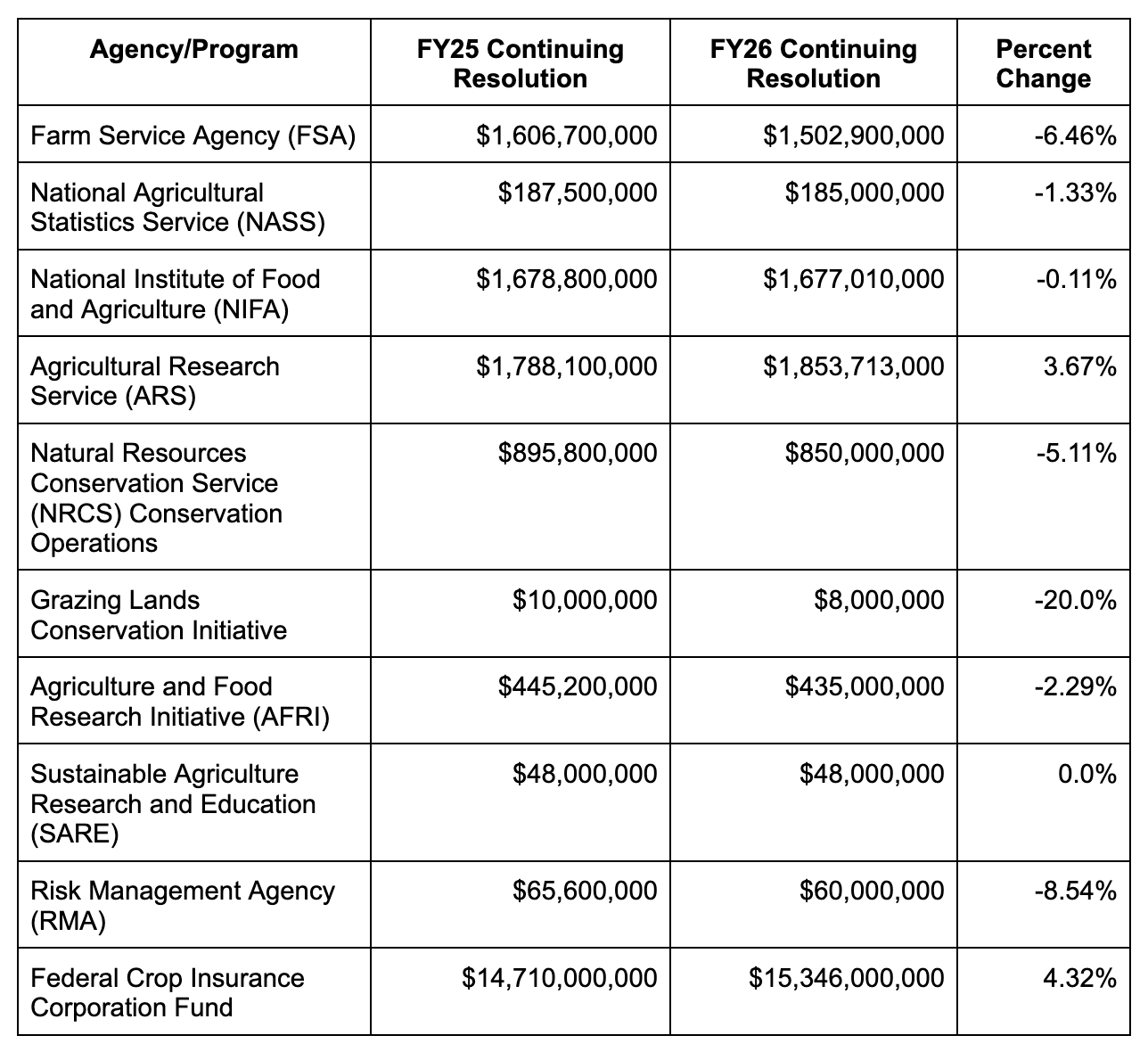
Chart of FY25 and FY26 agency/program funding changes.
Other notable changes in the funding package include:
Provisions included in the funding package could make it harder for USDA to continue cutting staff/offices from the agency. The bill designates $15+ million for hiring new FSA employees to fill vacancies at county offices and farm loan positions (many filling positions that were cut earlier this year). Additionally, the bill requires the USDA Secretary to obtain Congressional approval before removing programs, relocating offices/employees, and otherwise reorganizing USDA operations. This reversal of the administration's prior plans to close dozens of field offices and relocate 2,500+ employees helps protect conservation programs and technical assistance services that farmers depend on for implementing soil health practices.
The bill also includes a replenishment of the Commodity Credit Corporation Fund, which can hold up to $30 billion, that the president may leverage for upcoming farm aid in response to unstable soybean markets and tariff impacts. Farm and conservation groups are already strategizing about how to ensure any relief payments are well distributed among smaller producers, in addition to the biggest operations.
Additional Resources:
Accompanying Congressional Record with Explanatory Statement for H.R.5371, providing details on agency and program funding.
Land Core’s previous Ag-Appropriations Updates: Mini-Blog Part I and Part II
For further reading on the implications of the FY26 appropriations, see the National Sustainable Agriculture Coalition’s (NSAC) analysis, and the organization’s FY26 appropriations chart.
Land Core is a 501(c)3 organization that works closely with the USDA, legislators, producers, scientists, NGOs, and financial institutions across the country to develop policy recommendations that build healthy soils, resilient farmers, and national food security. This includes guiding the successful passage of language in both the House and Senate, supporting soil health outcomes at the USDA, and helping to secure over $50M in federal investment in Soil Health in the 2018 Farm Bill.
Contact: Aria McLauchlan, Co-Founder & Executive Director, aria@landcore.org