





Policy
Making our public infrastructure work for us

Land Core believes soil is our common ground. This informs our pragmatic, non-partisan approach to soil health policy, elevating the voices of farmers, and building broad coalitions of support to put soil health at the center of a resilient food and agriculture system.
Much like a think tank, we listen deeply and distill issues to develop actionable solutions, and serve as on-the-ground advocates and educators.
By selecting our moments carefully, Land Core has been able to have an outsized impact on the national soil health conversation. From the annual Appropriations cycle to the every five-year Farm Bill, we work closely with Congress and USDA to develop and implement sound policies that help our producers stay profitable, productive and resilient.
We also advise coalitions and other organizations on how to engage effectively in federal soil health policy.
Policy Wins

FY20 Appropriations
Built a broad coalition and passed report language in the House & Senate to establish national protocols for soil health verification at USDA-NRCS. Learn more →

Soil Health Demo Trials
Helped pass the Soil Heath Demonstration Trials in the 2018 Farm Bill and secured $50M in funding for the program. Learn more →

Rulemaking Success
Delivered thorough recommendations and additional support to ensure NRCS-CIG developed a robust process for measuring soil health results. Learn more →
Mobilizing Coalitions
Helped engage hundreds of farmers, farming orgs, national brands and businesses, NGOs and academics to sign on and actively support resilient soil health legislation. Learn more →
Sign the Letter of Support for the SOIL HEALTH Practices Act
Complete this sign-on form for the Letter of Support regarding the SOIL HEALTH Practices Act.
The letter advocates for USDA-RMA to oversee research of the risk reduction associated with cover cropping, reduced tillage, diversified rotations, managed grazing, and other soil health practices over a 3-5 year timeline. If the research indicates reduced risk, USDA would be required to recommend appropriate discounts or incentives for producers in crop insurance.
The path forward isn't locked in yet: this could move through appropriations, the Farm Bill, or another legislative vehicle, but the work continues regardless, and momentum is building.
The sign-on deadline has been extended, so if you or your organization, company, business, or institution didn't get a chance to sign on, or if you know others who should be part of this effort, please do so now!
Soil Health Federal Bill Tracker
This tracker highlights bills introduced into U.S. Congress that would impact soil health and resilience. This expanded version now features analysis and talking points, and is intended to be a robust source of information and potential engagement for the soil health community. To receive periodic updates when new bills are added or major action is taken in Congress, join the bill tracker alerts list.
Memos, Comments & Hearings
Here, a selection of memos and comments submitted during Congressional hearings, rulemaking and other opportunities for public comment.
Risk Modeling

Building a Predictive Model of Risk
Land Core is proud to share our project to build an actuarially-sound, predictive model of the risk-mitigating benefits of soil health practices, designed as a tool to inform lenders and insurers.
Although there is a general understanding that healthy soils can mitigate risk in agriculture (by increasing resilience to flooding and drought, etc.), institutions that price risk, such as banks and insurers, do not yet have a clear and effective way to incorporate these benefits into their risk pricing today.
We have convened a remarkable, cross-sector working group, to build a model that can generate a risk score for individual farms or ranches, such that actuarially-appropriate pricing can be developed. With that information, farmers and ranchers with a plan to implement soil health practices can receive meaningful economic benefits, such as discounted insurance premiums or lower rate loans.
The Land Core Risk Model will be:
A pragmatic decision-making tool to inform agricultural finance and insurance
Actuarially sound
Able to assign a risk score based on an individual producer’s soil health practices
Piloted at regional scale in the U.S. midwest
Crop Rotation Reduces Revenue Risk
Read this summary of our recent findings showing that a two-crop to a three-crop rotation consistently maintained or modestly improved mean corn revenue across farm sizes and the majority of counties studied, while also reducing farmers' vulnerability during periods of yield losses, whether they are cushioned by negative price-yield correlation, or whether they coincide with price weakness.
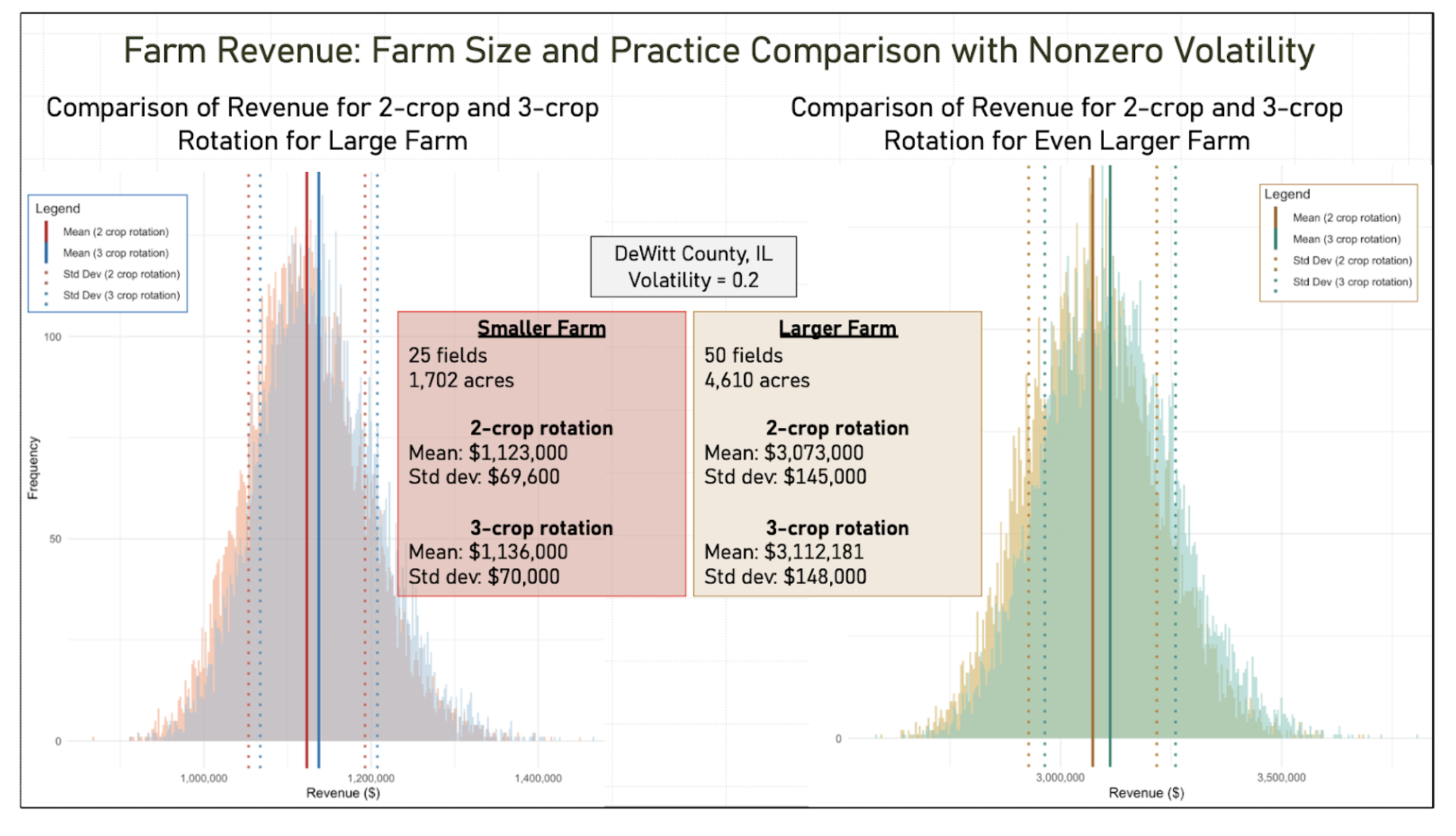
In agriculture, financial survival depends not simply on harvest size, but on revenue: what a field produces, multiplied by what the market will actually pay for it. These two forces do not move independently, and in most Midwest counties, when local harvests are poor and supply tightens, prices tend to rise, offering farmers a partial natural cushion. Even so, commodity price swings contribute roughly three to four times more uncertainty to farm revenue than yield variability does, meaning that market risk, not weather, is the dominant threat to a farm's bottom line.
This study evaluates farm revenue risk from two complementary perspectives: the individual farmer, whose exposure is shaped by local grain prices and their own fields' productivity, and the farm lender or insurer, who must account for variability across an entire county. Against that backdrop, the central question is whether the agronomic benefits of diversified crop rotations translate into a meaningful financial benefit, meaningful financial risk reduction, and/or no harm to the bottom line, once the scale of price uncertainty is fully accounted for. Our findings indicate that they do.
Crop Rotation Reduces Yield Risk
Check out this summary of our recent findings demonstrating how soil health practices, particularly crop diversification, affect corn yields under varying climate conditions across 5 Midwestern states.
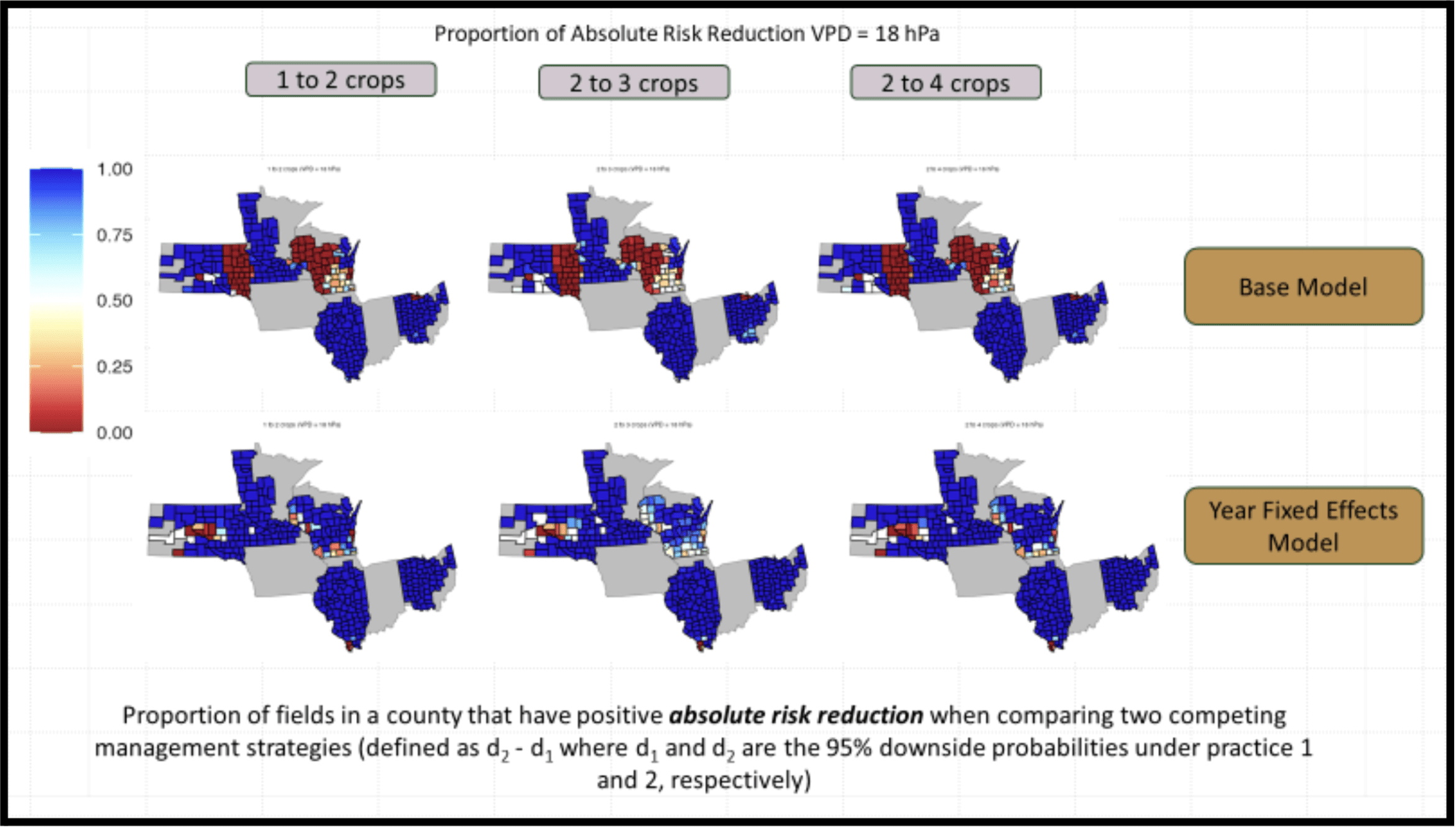
Using Bayesian hierarchical models, our research quantifies the risk-mitigating effects of soil health land management practices, showing that increased crop rotational complexity reduces risks related to both yield and revenue for farmers. The analysis integrates economic modeling to account for commodity price volatility, revealing that soil health practices help farmers reduce downside risks while capturing more value from ecosystem services.
These findings demonstrate that crop diversification consistently reduces yield risk for the vast majority of Midwest farmers across diverse weather conditions and geographic regions. The modeling framework provides critical evidence that soil health practices deliver measurable risk-mitigation benefits without sacrificing crop performance, offering valuable insights for farmers, insurers, and policymakers working to build more resilient agricultural systems.
View Beta Risk Model Tool

Check out the first version of our interactive, online Soil Health Risk Model Tool, developed in partnership with the Schmidt Center for Data Science & Environment. See how diversified crop rotations impact corn yields in Illinois under dry conditions.
In the News
AgFunder News: Should ag lenders and crop insurers offer ‘good soil discounts’ to farmers? Land Core develops ‘actuarially sound model’ to make it possible
August 4, 2023
“Insurers offer discounts for avoiding smoking and good driving because these practices are proven to mitigate risk and save them money. So should insurers and agricultural lenders offer farmers that look after their soil a ‘good soil discount’?
While it’s generally understood that cover cropping, reduced tillage, and crop rotations benefit soil, these practices are by no means ubiquitous, not least because there are high upfront costs, the benefits don’t come overnight, and there are no immediate financial incentives, says soil health nonprofit Land Core.
Insurers and lenders, meanwhile, do not currently offer discounts for farmers engaging in such practices because their specific impacts at the field level, especially on crop yields, have not been quantified, it says. Until now.”
Announcements


Risk Model Project Team
The Land Core Risk Model is being developed by a cross-sector, multi-disciplinary team, including agroecologists, statisticians, economists, and farmers.
Join Us
We’re seeking partners representing lending, investment and insurance to help inform model development. Partners also have the opportunity to develop and pilot incentives for producers.
Land Leases

Outcomes-Integrated Land Lease Program
Land Core is creating the first scalable, outcomes-verified land lease platform, to bring together landowners, producers and funding partners, to radically advance soil health adoption in America.
This early-stage initiative welcomes partners and funders to pilot the lease and build out the web platform.
Land Core is honored to participate in The Terraton Challenge and be selected by Indigo Ag as the top-ranking finalist in their “Reward” track.
Education

Building Common Ground
Land Core educates key stakeholders about the importance of soil health and amplifies the most opportune calls to action. Our work includes:
Advising Congress, USDA, and state officials on the potential of sound soil health policy
Educating businesses, NGO’s, funders, and educators on the importance of soil health as a path to greater resilience and profitability but also the role our government is playing in shaping agriculture
Hosting educational meetings and webinars with local farmer and rancher groups to share federal programs, technical resources, grants, and policy opportunities
New 1-Pager from Land Core!
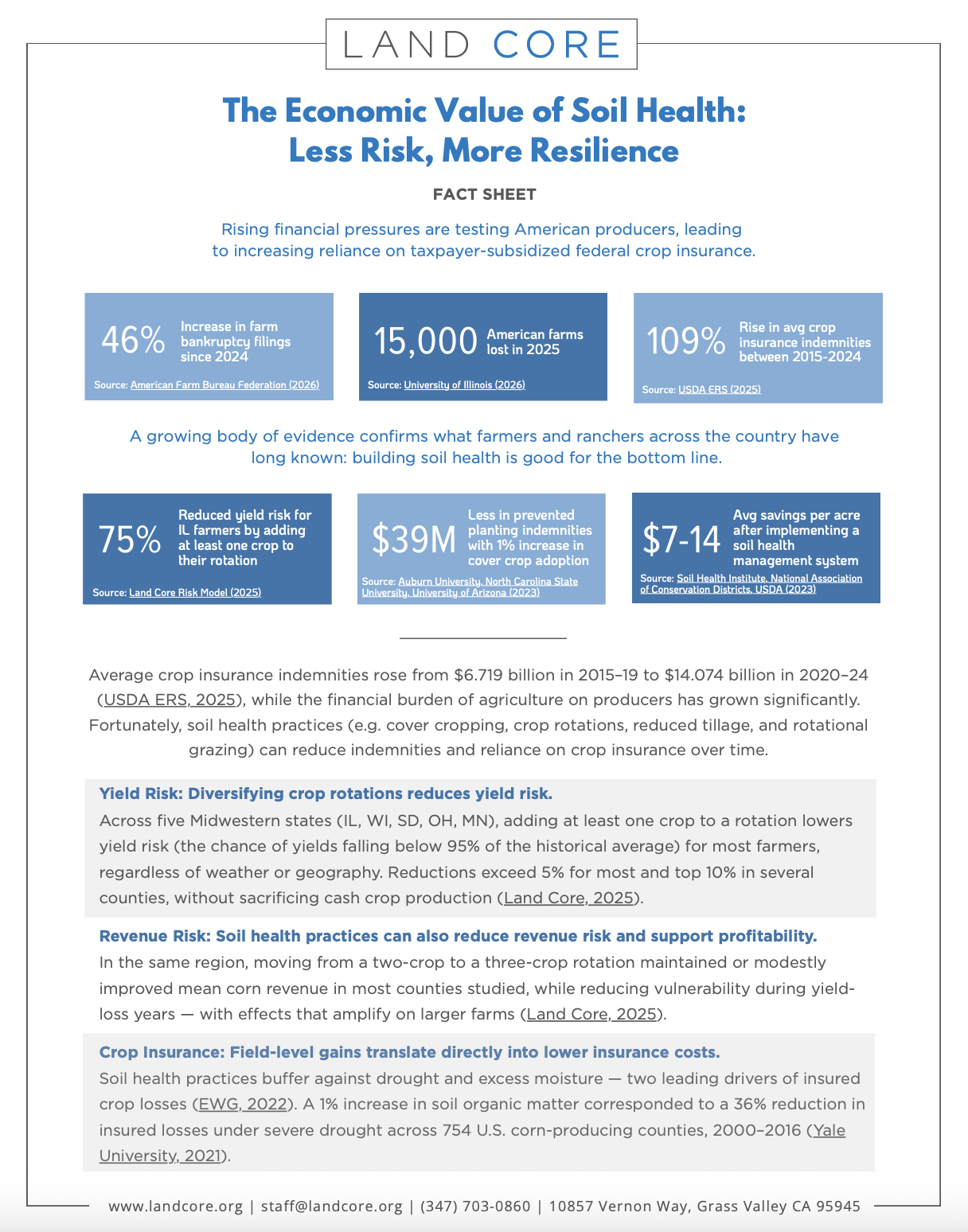
A growing body of research indicates that soil health practices, such as cover cropping, diversified crop rotations, reduced tillage, and rotational grazing, measurably reduce risk.
This new fact sheet from our team, “The Economic Value of Soil Health: Less Risk, More Resilience," distills the evidence into a single 1-page resource for policymakers, producers, financial stakeholders, soil health advocates, and partners nationwide.
The 1-pager draws on Land Core's own FFAR-funded risk modeling research alongside findings from institutions including Auburn University, North Carolina State University, the University of Arizona, USDA, the Soil Health Institute, and Yale University.
Ag Insights
Read and share written pieces from the Land Core team designed to offer a new perspective on hot issues in soil health, agriculture and resilience.


Soil Health Resources
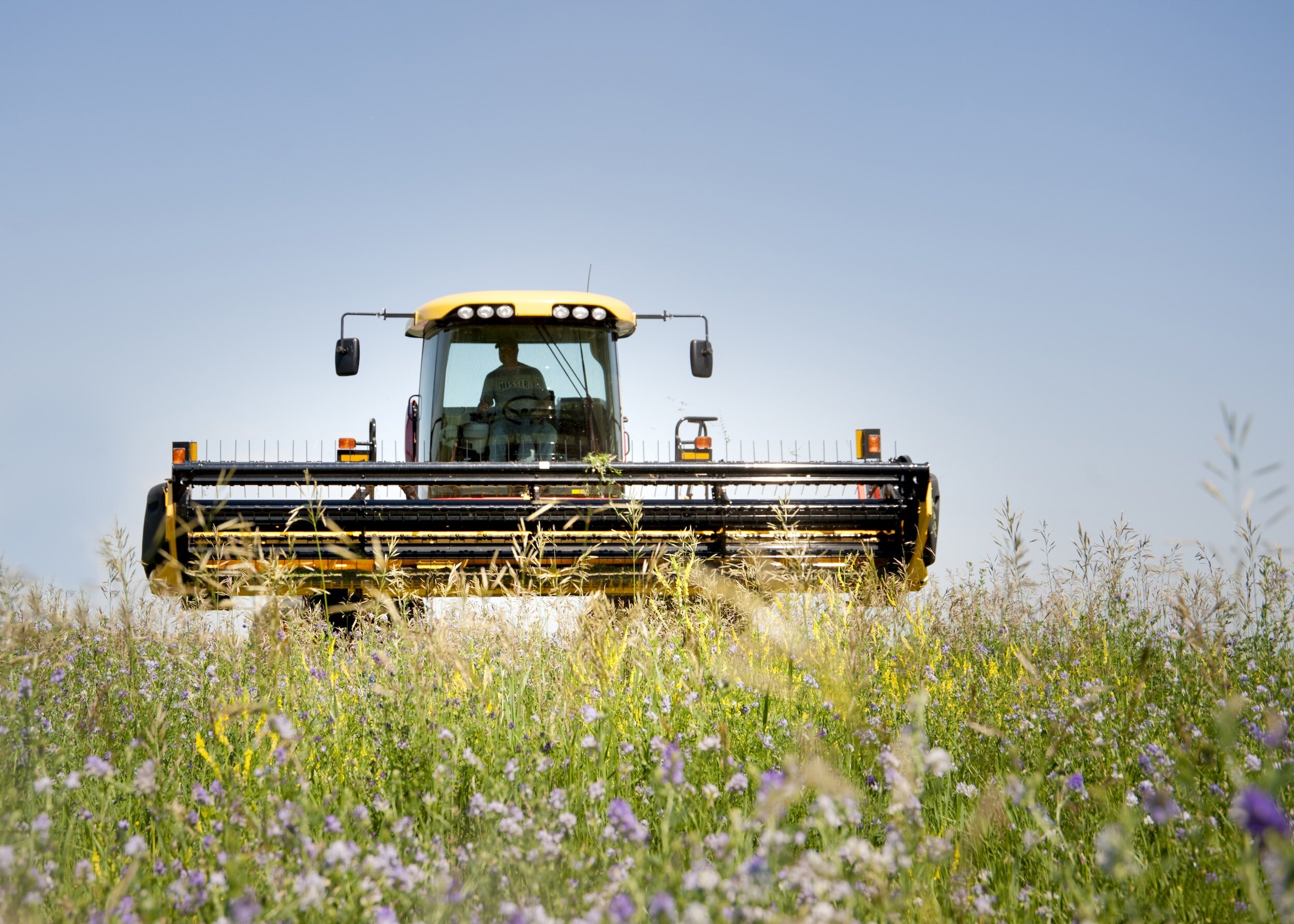
Dig into handy resources we’ve compiled, covering a range of important research, case studies and funding sources, on topics including the economics of soil health, and the case for soil health as a risk mitigation tool.
Other News
Catch up on Land Core’s monthly newsletters, federal bill tracker alerts, recent speaking events and other updates.