
Land Core Newsletter - March 2026
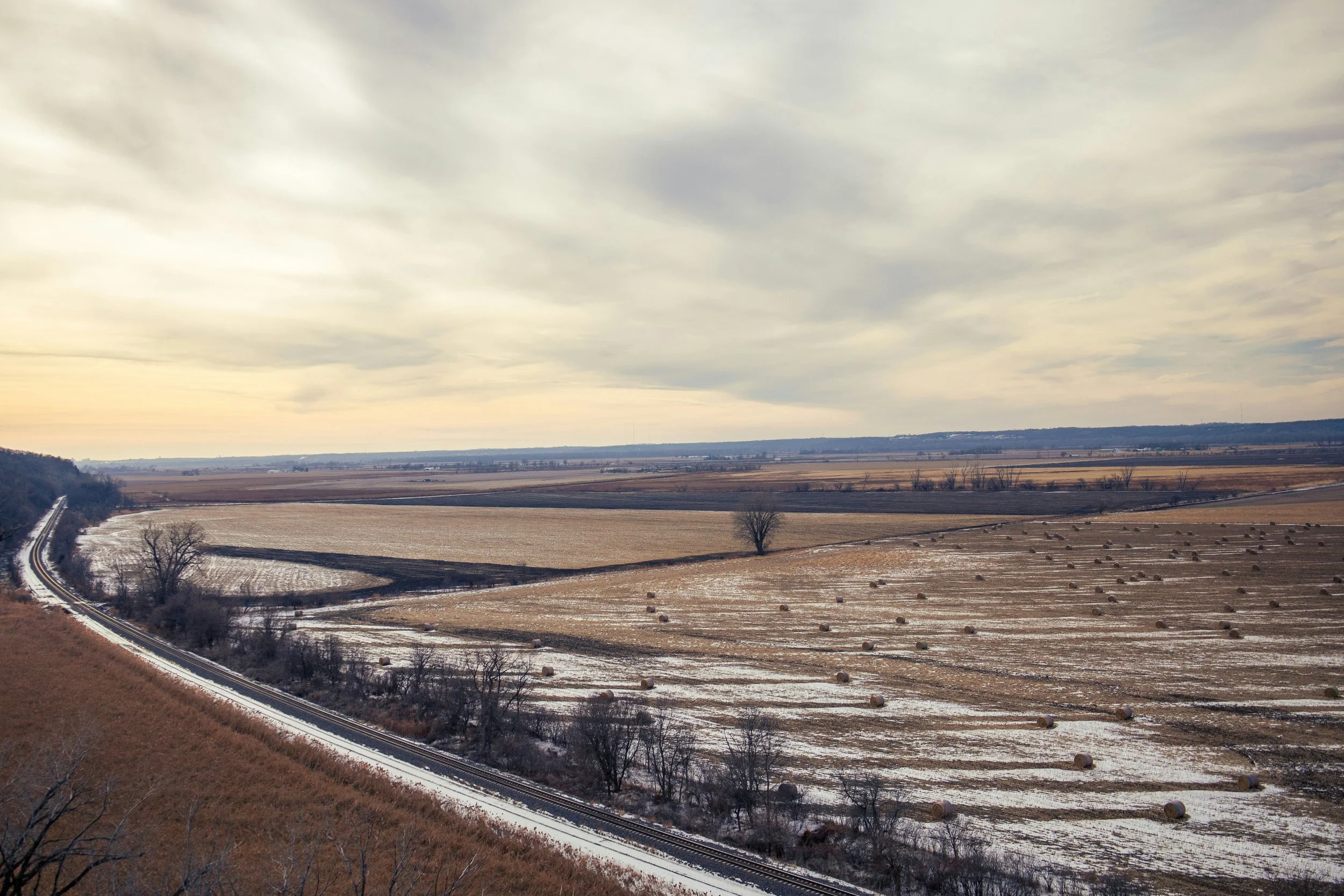
Image by Robert Gareth on Unsplash+.
Dear friends & colleagues,
Spring has a way of reminding us what's at stake and what's possible. As soil temperatures rise and planting decisions are made across millions of acres, we’re continuing our work to advance federal soil health policy and support farmers nationwide.
It’s been a busy month for agriculture policy. The House Agriculture Committee passed its version of the Farm Bill out of committee in early March with notable bipartisan support. In addition, agriculture appropriations requests are already being submitted for FY27.
At the same time, producers are navigating a complex landscape: staffing shortages at USDA, an unclear path for the farm bill in the Senate, and a farm economy rattled by rising fuel and fertilizer costs as well as market volatility, all exacerbated by the war in Iran.
Farmers need agriculture policy that meets them where they are, understands their day-to-day challenges, and allows them to build resilience and access new markets. Land Core is staying squarely focused on making sure soil health is central to that conversation.
Read on for federal policy updates, Land Core’s FY27 ag appropriations requests, new revenue risk findings from our Risk Model Team that make a compelling economic case for diverse crop rotations, upcoming events, and what we’re reading.
Warmly,
The Land Core Team
A Gift That Grows: Support the Soil This Spring
As the growing season begins, there's no better time to invest in soil health. Consider making a donation to Land Core or giving in honor of a farmer, family member, or friend who cares about the future of our food & agriculture system.
Land Core is the only organization fully focused on advancing federal policy and financial incentives for soil health in both the public and private sectors, bridging political divides, and creating real economic value for farmers. Whether you give as an organization or an individual, through a one-time donation or a small monthly contribution, your support makes a tremendous difference.
This spring, give a gift that nourishes the land that sustains us all — support Land Core today.
Federal Policy Updates
Image by Aria McLauchlan.
LEGISLATIVE UPDATES
The SOIL HEALTH Practices Act
Before the House Farm Bill markup, Land Core circulated a Letter of Support for the SOIL HEALTH Practices Act, a legislative proposal that directs the Risk Management Agency (RMA) to conduct a study assessing the risk-reducing benefits of soil health practices (e.g., cover crops, crop rotations, reduced tillage, and rotational grazing) over 3-5 year timeframes and develop actuarially-sound discounts or incentives, if appropriate. The Letter of Support has received the endorsement of 78 organizations and was shared with leaders of the House Agriculture Committee in advance of the markup. Our work on this front continues as we build support for the proposal in Congress and with national-level agricultural organizations. Read the latest update on the SOIL HEALTH Practices Act on the Land Core blog.
Farm Bill
Markup of the House Republican-led version of the Farm, Food, and National Security Act of 2026 (H.R.7567) began on Tuesday, March 3, and over twenty hours of debate culminated in a vote for its passage (34-17) out of the House Agriculture Committee on Thursday, March 5. Seven Democrats on the House Agriculture Committee voted to advance the bill along with their Republican colleagues, including Reps. Jim Costa (D-CA-21), Sharice Davids (D-KS-3), Don Davis (D-KS-3), Adam Gray (D-CA-13), Kristen McDonald Rivet (D-MI-8), Josh Riley (D-NY-19), and Gabe Vasquez (D-NM-2). During markup, the House Agriculture Committee considered over 100 amendments and adopted over 40.
At the Agri-Pulse Ag & Food Policy Summit on Monday, Senate Agriculture Committee Chairman Boozman and Ranking Member Klobuchar both reaffirmed their commitment to a bipartisan farm bill, with the Chairman noting that his Committee's legislative text would come "in the coming weeks, not months and months." Still, several contentious policies continue to strain the broad coalition that has historically made passing this sweeping omnibus bill possible, making it difficult to predict if we will, in fact, get a farm bill across the line in this Congress.
FY27 Ag Appropriations
As the FY2027 appropriations cycle continues, many Congressional offices have open portals on their websites for constituents and organizations to submit programmatic and report language requests for the annual spending bills. While submission deadlines for members of the House Appropriations-Agriculture Subcommittee have passed, many members of the Senate Appropriations-Agriculture Subcommittee remain open to requests.
Land Core is currently submitting requests to all Ag Committee member offices. For more information on Land Core’s FY27 Appropriations priorities, see our specific requests here.
AGENCY IMPLEMENTATION: COMMENTS TO USDA
Letter to USDA from Regen Policy Initiative
Land Core contributed to a set of policy recommendations led by the Regen Policy Initiative (RPI), a coalition of farming groups and other organizations, in response to USDA’s new Regenerative Pilot Program at the Natural Resources Conservation Service (NRCS). The recommendations focus on strengthening whole farm conservation planning, establishing standardized soil health testing and outcomes measurement, and investing in soil health education and technical assistance for both NRCS staff and producers. The letter will be shared with USDA Secretary Brooke Rollins, her leadership team, and NRCS Assistant Chief Jimmy Emmons and is intended to help ensure the pilot program is set up for long-term success. The deadline for signing on has been extended to March 30, 2026; individuals and groups interested in indicating their support of this letter can sign on here.
Letter to USDA from AGree Coalition
Last week, Land Core signed on to a letter from the AGree Coalition in response to USDA’s February 20 Request for Information (RFI) on "Opportunities, Challenges, and Emerging Areas in Statistical Data, Analysis, and Research at USDA." The RFI is open for public comment until April 9. As a member of the Agree Coalition, Land Core signed on to these comments on the RFI, which urge the agency to improve how it collects, links, and analyzes agricultural data, particularly on conservation practices like cover crops and no-till, to help farmers make better decisions and reduce production risk. It specifically recommends that USDA support the Thune/Klobuchar Agriculture Innovation Act of 2025 and adopt six data improvements, including annual field-level data collection, standardized geographic identifiers, and broader researcher access to USDA datasets.
New Risk Modeling Results Now Available!
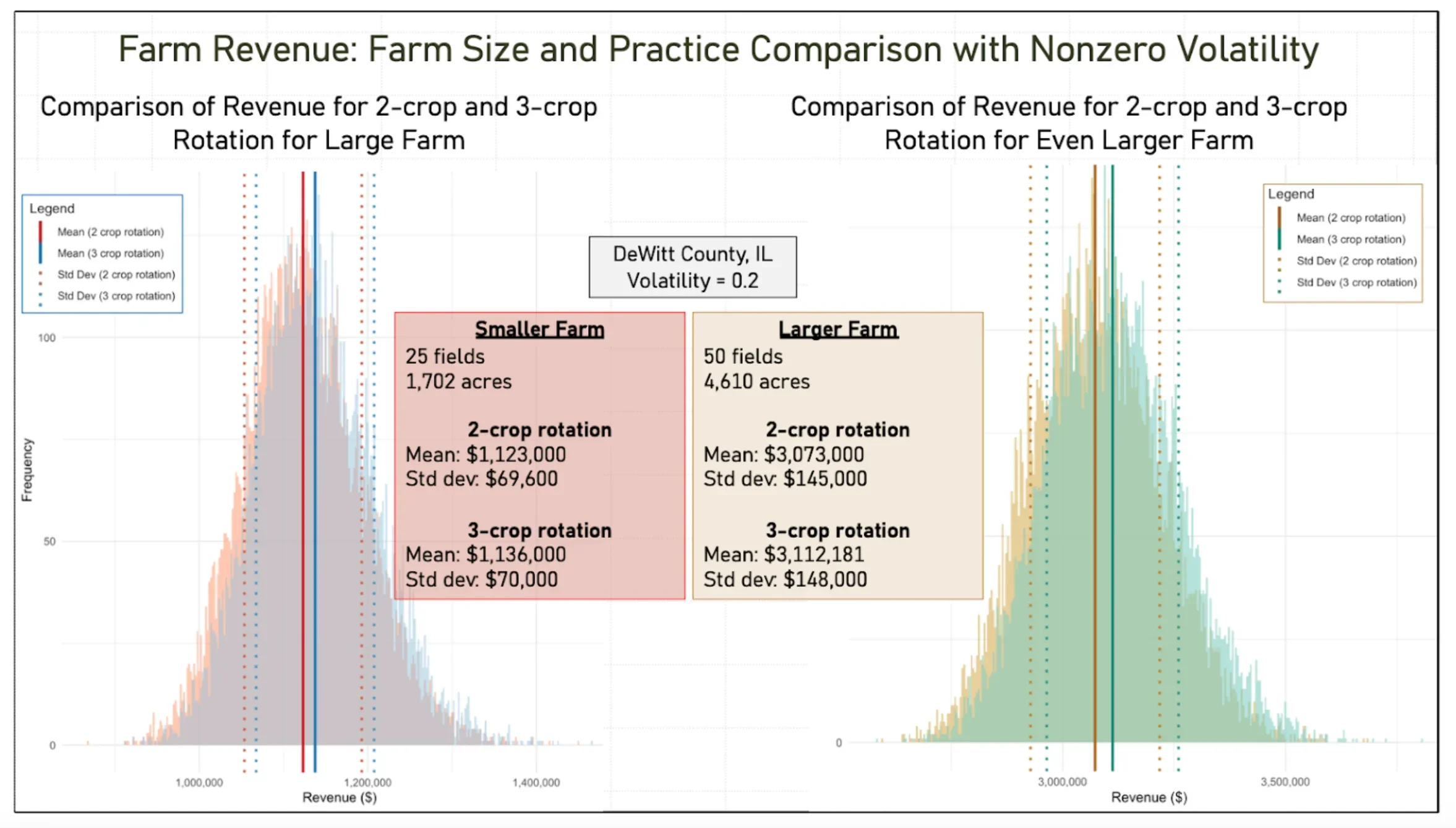
This figure from Risk Model Team Member, Dr. Gina Pizzo, displays that larger farms show lower “per-acre revenue uncertainty” through diversification, and in both farm sizes, three-crop rotations (blue) modestly but consistently outperform two-crop rotations (red) across the full revenue distribution.
We’re thrilled to share new research from our Risk Model Team examining whether soil health practices, specifically increasing crop rotation complexity, can stabilize revenue against the dominant force in farm finances: commodity price swings. The findings offer reassuring news: moving from a two-crop to a three-crop rotation consistently maintained or improved mean corn revenue across farm sizes in five Midwest states, while also reducing yield-driven downside risk. In other words, more diverse rotations won't be drowned out by market noise, and rather, they act as a financial floor when a farmer is hit by low prices and low yields simultaneously.
Bill Tracker Updates
Image from Unsplash+.
With the recent House Farm Bill markup and FY27 ag appropriations requests currently being submitted, there is significant movement in the ag policy space, and Land Core is staying on top of it.
Keep an eye out for our Federal Soil Health Bill Tracker Alert coming later this month, and make sure you’re signed up for our quarterly alerts here.
Follow Land Core on Socials!
Upcoming Events
Image by Riccardo Atrot on Unsplash+.
March 31, 2026 – Building Audience-Centered Presentations | Conservation Voices (Virtual - 2p-3p ET)
Join the Soil and Water Conservation Society for this one-hour webinar designed to help conservation professionals, students, and educators create more compelling presentations. The webinar will share practical tips so your message lands clearly, whether you're presenting to farmers, funders, or community members. Learn more and register here.
April 27-28, 2026 – Immersive Introduction to Regenerative Agriculture (Bluffton, GA)
Join the Center for Agricultural Resilience at White Oak Pastures for an intensive 14-hour, two-day program led by the farm's field managers and Harris family members. The workshop blends hands-on fieldwork and classroom sessions covering multi-species animal impact strategies, pasture rotation, soil health, and chemical-free farming practices. Class size is limited to 16 participants for a personalized experience. Learn more and register here.
April 29-30, 2026 – RegenerativeNYC (Brooklyn, NY)
Join farmers, investors, researchers, brands, and supply chain leaders for two days of talks, workshops, and networking focused on the future of regenerative food systems. Sessions cover soil health, carbon and climate, farm profitability, biodiversity, ag policy, and food waste. Learn more and register here.
May 4, 2026 – From the Ground Up: Finance and the Future of Regenerative Agriculture | Film Screening and Discussion (Virtual - 12p-1p PT)
Join Sustainable Agriculture and Food Systems Funders (SAFSF) and Croatan Institute for a virtual double-feature screening of Digging In and Soil Wealth: Investing in Regenerative Agriculture, followed by a moderated panel with funders, investors, and field leaders exploring how grantmaking, investing, and lending can better support the transition to regenerative systems. Note: This event is reserved for funders and designed for philanthropic and investment leaders who are already funding in this space or exploring their next steps. Learn more and register here.
What We're Reading
Image by Stefano Toro on Unsplash+.
Nearly 150 USDA County Offices Have No Conservation Staff, New Data Shows
A new analysis reveals that 144 USDA county offices lost all their conservation staff in 2025, leaving farmers without the on-the-ground help they need to enroll in conservation programs. Experts warn this will disproportionately hurt small farms and could undermine the White House's own regenerative agriculture agenda.
By Lisa Held, Civil Eats, March 23, 2026
This blog post from Cato Institute argues that the federal crop insurance program is effectively permanent welfare for wealthy farm businesses, with taxpayers expected to pay $14.7 billion in 2026, including $5.1 billion in payments to private insurance companies, while offering no income limits, meaning the top 10% of farms capture 56% of all subsidies.
By Chris Edwards, Cato at Liberty, March 19, 2026
A new study found that regenerative agriculture, specifically adaptive multi-paddock grazing and high-performing pasture species, improved productivity, profitability, and GHG emissions on Australian sheep farms, though the research also found that practices delivering the greatest environmental benefits don't always maximize profit, underscoring the need to balance economic and environmental goals in farming system design.
By Albert Muleke, Karen Michelle Christie-Whitehead, Michelle Cain, Ke Liu, Paul John Burgess, Catherine Wiltshire, Georgios Pexas & Matthew Tom Harrison, Nature Food, March 13, 2026
Following the January removal of Venezuelan President Nicolás Maduro, the Trump administration expanded sanctions waivers on Venezuela, allowing U.S. entities to purchase Venezuelan fertilizer and petrochemical products, invest in Venezuela's electricity and petrochemical sectors, and negotiate contingent contracts for new energy projects. The move aims to ease rising fertilizer and fuel costs hitting American farmers amid the U.S.-Israel conflict with Iran, though it remains unclear how much fertilizer Venezuela has available to export or how quickly it would reach the U.S.
By Jarrett Renshaw, Reuters, March 13, 2026
This op-ed by Brooks Lamb of the American Farmland Trust argues that the primary barriers keeping young people from farming aren't lack of interest or work ethic, but rather historically high land prices, cultural discouragement, and limited economic viability. With 300 million acres expected to change hands over the next two decades, Lamb calls on Congress and state leaders to expand conservation easements, low-interest loans, and down payment assistance programs to help the next generation access land.
By Brooks Lamb, NY Times, March 13, 2026
Fertilizer Stocks Jump With Shipments Stuck at the Strait of Hormuz
A war-driven surge in fertilizer prices is rattling U.S. agriculture, as conflict in the Middle East has blocked major supplies of ammonia, urea, and phosphates from the Persian Gulf while driving up natural gas costs for overseas producers. American farmers are being forced into difficult planting decisions this spring, while U.S. fertilizer producers like CF Industries are emerging as market winners due to their access to cheaper domestic natural gas.
By Patrick Thomas, The Wall Street Journal, March 12, 2026
New Rockefeller Foundation Research Finds ‘Food is Medicine’ Could Unlock $45 Billion for States
New Rockefeller Foundation research finds that scaling "Food is Medicine" programs, which provide produce prescriptions and medically tailored meals to people with diet-related conditions, could generate over $45 billion in economic activity and create 316,000 jobs nationwide. Critically for agriculture, small and mid-sized farms could capture $5.6 billion in new revenue, with soil health and regenerative practices emerging as direct beneficiaries when states prioritize local sourcing in program design.
By The Rockefeller Foundation, March 11, 2026
A student farming program is expanding in urban schools. Here's what city kids get out of FFA
FFA (Future Farmers of America) chapters, once associated almost exclusively with rural America, are growing in urban and suburban schools nationwide. Programs are using hydroponic farms and hands-on agriculture science classes to expose city students to the full spectrum of the food and agriculture industry. Advisors say the goal isn't just to train future farmers, but to open students' eyes to the vast career opportunities rooted in agriculture.
By Katie Grawitch, Harvest Public Media / KCUR-NPR, March 9, 2026