
Land Core Newsletter - May 2026

Image from Unsplash+.
Dear friends & colleagues,
This month brought a significant milestone for soil health and our top policy priority, and we're excited to share it with you!
Report language was included in the committee report (see pg. 55) accompanying the House Appropriations Committee's FY2027 Agriculture-FDA spending bill. It directs RMA to study the risk-reducing benefits of soil health practices, propose policy changes that acknowledge any risk reduction and develop appropriate incentives across commodity crop insurance policies. This language substantively mirrors the objectives of the SOIL HEALTH Practices Act (our farm bill priority), and its inclusion is a meaningful step toward federal recognition of what farmers implementing these practices already know: healthy soils reduce risk. Land Core is now actively working to get this language included in the Senate's version of the Appropriations language.
On the broader policy front, the Farm Bill has cleared the House, while the Senate is expected to release their respective version of the bill around mid-June, keeping the legislative calendar (and our schedules) full.
Meanwhile, new data from our risk modeling team will soon be freely available to researchers. Also, a strong showing at Regenerative NYC signals that the evidence base for regenerative agriculture is continuing to mature, even as the field acknowledges how much work remains.
Read on for updates on FY27 House Ag-Appropriations, Farm Bill progress, an open position on our team, upcoming events, and what we're reading this month.
With gratitude,
The Land Core Team
Policy Updates
Image from Unsplash+.
FY27 House Ag-Appropriations
The House Appropriations Subcommittee on Agriculture convened on April 23 to markup the FY2027 Agriculture, Rural Development, Food and Drug Administration, and Related Agency Appropriations Act, and Subcommittee members voted to approve the legislation. Shortly after, on April 29, the full House Appropriations Committee conducted its own markup of the bill, during which the measure was advanced out of the Committee by a vote of 35 to 25, almost entirely along party lines, with Rep. Gluesenkamp Perez (D-WA-03) as the sole Democrat to vote with Republicans in support of the bill. The Senate Appropriations Committee has not yet released bill text or scheduled the chamber’s markup.
Farm Bill
The House successfully passed its version of the Farm Bill, formally known as the Farm, Food, and National Security Act of 2026, on April 30, following the successful adoption of an amendment that stripped the pesticide liability shield from the bill’s text, along with a deal to hold a separate vote on year-round E15 (this standalone vote was successfully approved on May 13). The vote was tallied at 224 to 200, with 209 Republicans, 14 Democrats, and 1 Independent voting to advance the bill, while 197 Democrats and 3 Republicans voted against the measure.
While the Senate has not officially announced its timeline for the chamber’s Farm Bill work, we’re hearing from partners that Senate markup is likely to occur around mid- to late-June. The Senate is expected to omit certain controversial provisions related to pesticides and livestock in its version. More recently, Senator John Boozman (R-AR), Chairman of the Senate Agriculture Committee, indicated his willingness to consider delaying the implementation of the contentious SNAP cost-share included in the enacted One Big Beautiful Bill Act, which would significantly increase the chance of a Farm Bill passing before the November elections. Stay tuned for news and action alerts in the early summer!
We’re Hiring a Policy Associate!

Imagr from Unsplash+.
We're hiring a Policy Associate to support our soil health, risk, and resilience policy and advocacy work. This role will lead our Soil Health Bill Tracker, monitoring legislation across conservation, crop insurance, and risk mitigation, and support outreach to Congressional offices and other policymakers working to advance soil health at the federal level.
This is a part-time remote position well-suited for an early-career professional passionate about soil health and ag policy, with opportunities to learn and grow within the organization.
Learn more and apply here.
Social Highlights

We recently shared a social post highlighting how soil health can serve as a financial strategy for farmers amid rising input costs, particularly as urea prices surge and market volatility continues, emphasizing that practices like cover crops and diverse rotations offer measurable economic advantages this planting season. Follow and learn more on our social channels: Instagram, LinkedIn, Facebook & X.
Grow Something Lasting: Donate to Land Core
Spring is a season of planting, growth, and renewal, and there's no better time to invest in the soil that makes it all possible. As farmers head into the fields this planting season, your support helps Land Core work to ensure they have the policy backing and financial incentives they need to build healthier soil for the long term.
Land Core is the only organization exclusively focused on advancing federal policy and financial incentives for soil health, bridging political divides, and creating real economic value for farmers. Whether you give $25 or $250, or sign up for a small monthly donation, your contribution helps turn soil health from an aspiration into an economic reality for farmers across the country.
This spring, plant a seed for the future and support Land Core today.
Thank you to our Funders, #NoRegretsInitiative and Mighty Arrow Family Foundation!
We're thrilled to announce that Land Core has received a new three-year commitment from #NoRegrets Initiative, contributing $50k per year. We're also pleased to share that we've received the second installment of $50k for our three-year grant commitment from Mighty Arrow Family Foundation, a continued vote of confidence in our work.
Together, their support is instrumental in advancing our mission to build the business case for soil health and bring better risk tools to farmers, lenders, insurers, policymakers, and investors. We're deeply grateful for both partnerships.
Coming soon from our Risk Modeling Project…
We’ve successfully developed the first open-source, field-level, remotely-sensed dataset detecting cover crops in 9 Midwestern states, which we're working to make publicly available very soon for academic and non-profit users. Feel free to reach out if you’re interested in exploring the dataset. If you’re a for-profit or corporate partner interested in licensing the dataset, please contact staff@landcore.org for more information.
ICYMI
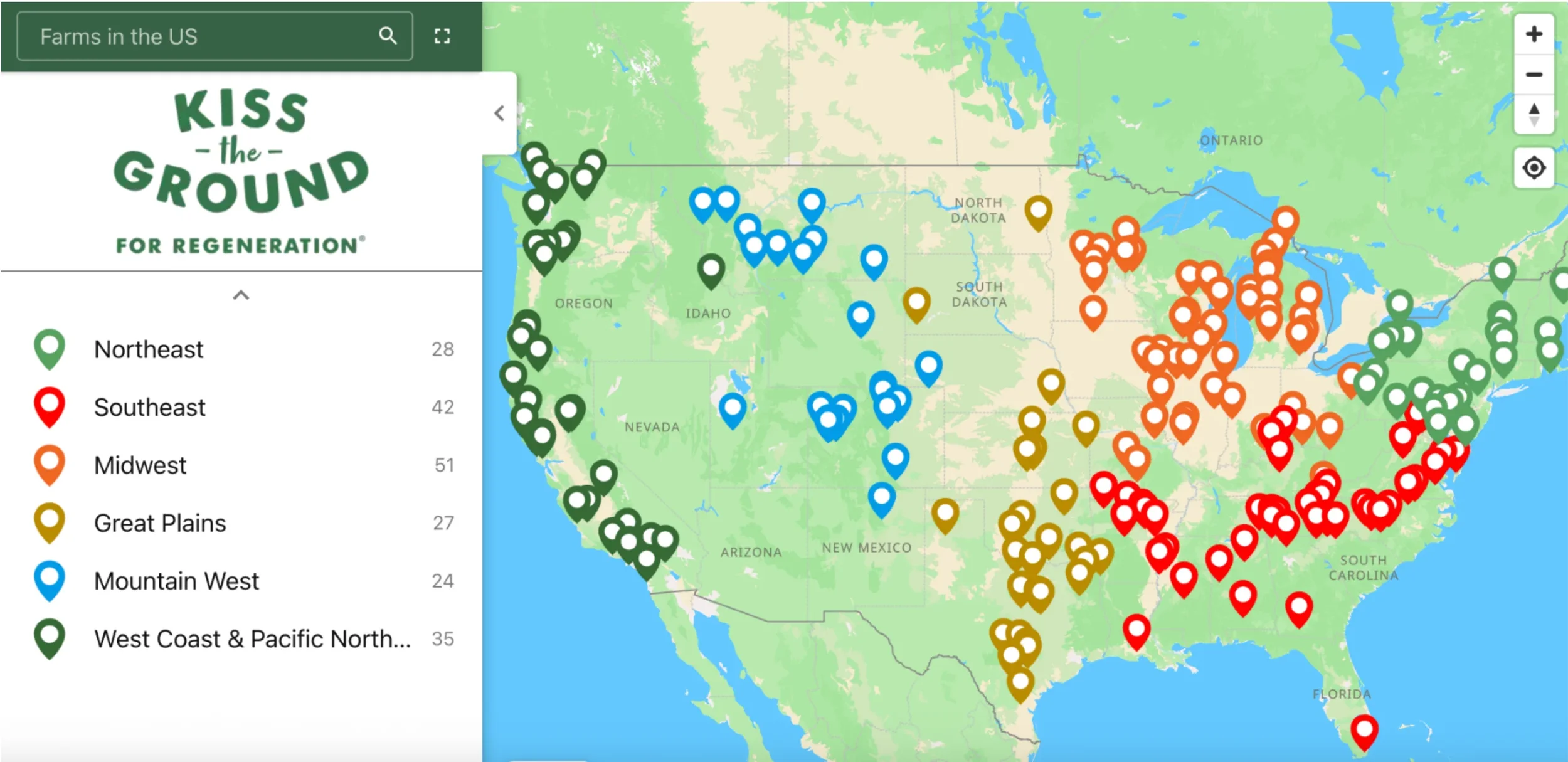
Image from Unsplash+.
Check out Kiss the Ground's new Regenerative Farm Map, which is a great tool for finding and supporting local farms practicing regenerative agriculture in your community. Their "5 with a Farmer" short video series is also worth a watch if you want a quick, two-minute introduction to some of the people growing our food.
Upcoming Events
June 9, 2026 - Regenerating Cincinnati: Farmers, Food, and Climate Solutions (Cincinnati, OH - 5p-7p ET): As part of Cincinnati Climate Week, join farmers, permaculturalists, educators, and healthcare leaders at MadTree Brewing to explore how regenerative agriculture can strengthen regional food systems, improve community health, and build climate resilience -- followed by open Q&A and networking. Register here.
June 16-18, 2026 - Soil & Climate Alliance Summer Network Meeting (Kutztown, PA - Rodale Institute): Join farmers, brands, certifiers, scientists, investors, and supply-chain leaders for a three-day on-farm gathering at one of the world's most influential centers of organic and regenerative agricultural research. Designed as a working meeting to deepen alignment and strengthen connections across the regenerative landscape. Register here.
July 1-2, 2026 - Groundswell Festival (Hertfordshire, UK - Lannock Farm): One of the leading gatherings in regenerative agriculture, Groundswell brings together farmers, growers, researchers, and food system leaders for two days of talks, debates, and practical demonstrations on regenerative farming systems. Get tickets here.
What We're Reading
Image from Unsplash+.
Could AI Be a Boon to Regenerative Agriculture?
This article examines how researchers and startups are deploying AI tools, including bioacoustic monitors for birds, bats, and bees and computer vision tools for insect identification, to help farmers measure biodiversity outcomes from regenerative practices. Proponents argue these tools can accelerate ecological assessment, while skeptics raise concerns about verification of results, environmental impacts, and data privacy.
By Meg Wilcox, Civil Eats, May 20, 2026
House passes bill for year-round E15 ethanol fuel sales, splitting Republicans
The House voted 218-203 to codify year-round sales of E15, a fuel blend of 15% ethanol and 85% gasoline, sales of which have traditionally been restricted in the summer. The bill drew support from corn-state members but faced opposition from members from oil-producing states with concerns about impacts on small refineries. As a result, the bill split both parties as 122 Republicans, 95 Democrats, and 1 Independent supported the measure, while 90 Republicans and 113 Democrats voted against it. The bill faces an uncertain future in the Senate.
By Emily Brooks, The Hill, May 13, 2026
Something weird and worrying is happening with rain, study finds
A new study found that global rainfall is becoming increasingly concentrated into heavier storms separated by longer dry spells, resulting in less water reaching soils, aquifers, and ecosystems even where total precipitation is rising. This shift poses a growing challenge for water resource managers, and is projected to intensify as global temperatures rise. The study could help underscore the need to improve soil health to both absorb and retain the heavy but intermittent rains.
By Doyle Rice, USA Today, May 13, 2026
House Farm Bill Faces Senate Pressure and Changes
This article reports that the House-passed 2026 Farm Bill now moves to the Senate, where regional interests and competing priorities could still reshape major provisions. The most contested remaining issues include SNAP funding, Proposition 12-related livestock rules, and pesticide liability language stripped from the House version.
By Tony St. James and Marion Kirkpatrick, RFD-TV, May 7, 2026
Three-quarters of USDA researchers tapped to relocate tell union they’re not going
An internal survey by AFGE Local 3403, the union that represents USDA researchers, found that 76% of its members affected by USDA’s plan to relocate Economic Research Service (ERS) and National Institute of Food and Agriculture (NIFA) employees from D.C. to Kansas City do not plan to relocate. The union warns the relocation will trigger a “brain drain”, delay NIFA grant processing, and risk research errors at ERS.
By Jory Heckman, Federal News Network, May 7, 2026
Roundup transformed farming in the U.S. Could it change regulation too?
This episode examines a pending Supreme Court case that could halt tens of thousands of cancer-related lawsuits against Bayer over glyphosate, the active ingredient in Roundup. Guests trace how the herbicide reshaped U.S. agriculture by enabling no-till farming and genetically engineered seed systems, while locking many farmers into a “pesticide treadmill” of rising chemical use, patented seed licensing fees, and declining glyphosate effectiveness.
By Leila Barghouty and Meghna Chakrabarti, WBUR, May 6, 2026
This research finds that cover crop fields in Tennessee had roughly 10% greater avian species richness and conservation value than row crop fields without cover crops, with five of 14 focal species, mostly grassland birds, showing greater occupancy in cover crop fields.
By David A. Buehler et al., Journal of Soil and Water Conservation, May 5, 2026
A new study found that winter cereal cover crops did not reduce dryland soybean yield, soil moisture, or soil nutrient levels across six site-years in the Florida Panhandle. Year-to-year yield variation was instead correlated with rainfall during critical reproductive growth stages, suggesting that environmental conditions exert a stronger influence on yield than cover crop presence.
By David N. Campbell et al., Journal of Soil and Water Conservation, May 5, 2026