
Land Core Newsletter - August 2026

Image by Susanne Nilsson on Flickr.
Dear friends & colleagues,
It's late summer, and across the U.S. farmers are deep into harvest decisions, watching weather, markets, and input costs closely. In Washington, agriculture policy had its own late-summer churn: the Farm Bill hit a real setback this month, not advancing from the Senate Ag Committee, and federal regulators spent much of August responding to a food system visibly under strain. We break it all down below.
Land Core remains focused on making the economic case for soil health as a risk-reduction strategy, and we're building on our recent “Economic Value of Soil Health” 1-pager with a new full policy platform, and we'd love your input as we shape it - more on how to get involved below.
Read on for federal policy updates, our summer reading list, this month's Paper of the Month, funding opportunities, and more.
With gratitude,
The Land Core Team
Federal Policy Updates
Senate Farm Bill
On Thursday, August 6th, the Senate Committee on Agriculture, Nutrition, and Forestry failed to report Chairman John Boozman’s (R-AR) Farm Bill to the Senate floor by a 10-11 party-line vote. According to Committee rules, Sen. Mitch McConnell’s vote-by-proxy for the bill through his continued absence did not count to advance the bill. His proxy vote did allow Republicans to unilaterally block amendments offered by Democrats, including ones on delaying the SNAP state cost-share requirement, restoring EQIP funding, preserving individuals' ability to sue pesticide companies for failure-to-warn claims, requiring audits on ARC payouts, and increasing funding for rural development programs. Notably, Sen. Thune’s amendment restoring mandatory country-of-origin labeling for beef passed with 17-6 bipartisan support.
The markup also opened with a slate of 30+ amendments adopted en bloc by voice vote, including several with implications for soil health:
Sen. Booker - Office of Small Farms
From the Office of Small Farms Establishment Act of 2026, creates an Office of Small Farms to streamline access to USDA programs for small farmers.
Sen. Slotkin- Foundation for Food and Agriculture Research (FFAR) funding
Authorizes $200 million in funding for FFAR.
Sen. Lujan - Local Food Purchase Assistance (LFPA)
Authorizes two years of mandatory funding for the Strengthening Local Food Security Program at $200 million per year, a program replacing the canceled Local Food Purchase Assistance Program.
Sen. Schiff - Specialty Crop Definition
Affirms the definition of specialty crops in Title 10, the Technical Assistance for Specialty Crops (TASC) program, and crop insurance authorities, as “Fruits and vegetables, tree nuts, dried fruits, horticulture, and nursery crops (including floriculture)”.
Sen. Lujan - Farmer to Farmer
From the Farmer to Farmer Education Act of 2025, expands farmer-led technical assistance through the support of farmer-to-farmer networks.
Sen. Hoeven - State Conservation
From the SCALE Act of 2026, establishing a grant program for States and Tribes to fund soil health and wildlife habitat programs on agricultural land.
Sen. Justice - FLOOD Act
From the FLOOD Act, adds the Emergency Watershed Protection Program to the list of USDA conservation programs eligible for coordination under the Regional Conservation Partnership Program.
Chairman Boozman has indicated he will resume the markup to vote again on the bill as amended when the Senate returns as soon as the second week of September.
Primary Results and Agriculture Committee Membership
Results from Minnesota’s Democratic primaries last Tuesday will mean major membership changes for both House and Senate Agriculture Committees next Congress. Senator Klobuchar, Ranking Member of the Senate Committee, won her gubernatorial primary and will advance to November’s primary elections, which she is likely to win.
House Committee on Agriculture Ranking Member Angie Craig lost her bid to run for the Senate. The Ranking Member seat, or the Chair if Democrats gain a majority in the House, is being campaigned for by Rep. Shontel Brown (D-OH-11), the current Vice Ranking Member. Politico reports that Rep. Brown has been receiving support in seeking the role, and is likely to be endorsed in her bid by the Congressional Black Caucus.
Food Safety News
The Food and Drug Administration (FDA) has released a plan to close the “generally recognized as safe” (GRAS) loophole in federal food regulation, which has allowed food manufacturers to introduce new ingredients in their products without notifying FDA regulators for more than two decades. Currently, food companies voluntarily self-certify that any new ingredients have robust evidence of safety for consumers; the proposed rule released last Monday would make reporting this information to FDA mandatory.
The Department of Health and Human Services and USDA have also announced the federal government's first official definition of “ultra-processed foods” is under final review.
Both announcements come after more than 10,000 people have been sickened in the cyclospora outbreak linked to Taylor Farms lettuce, making food safety issues a top headline of the summer, and driving more people to consider how their food is produced.
🌾 Donate to Land Core! Support our programs to advance soil health in 2026 and beyond.
ICYMI: Land Core’s New Economic Benefits of Soil Health 1-Pager
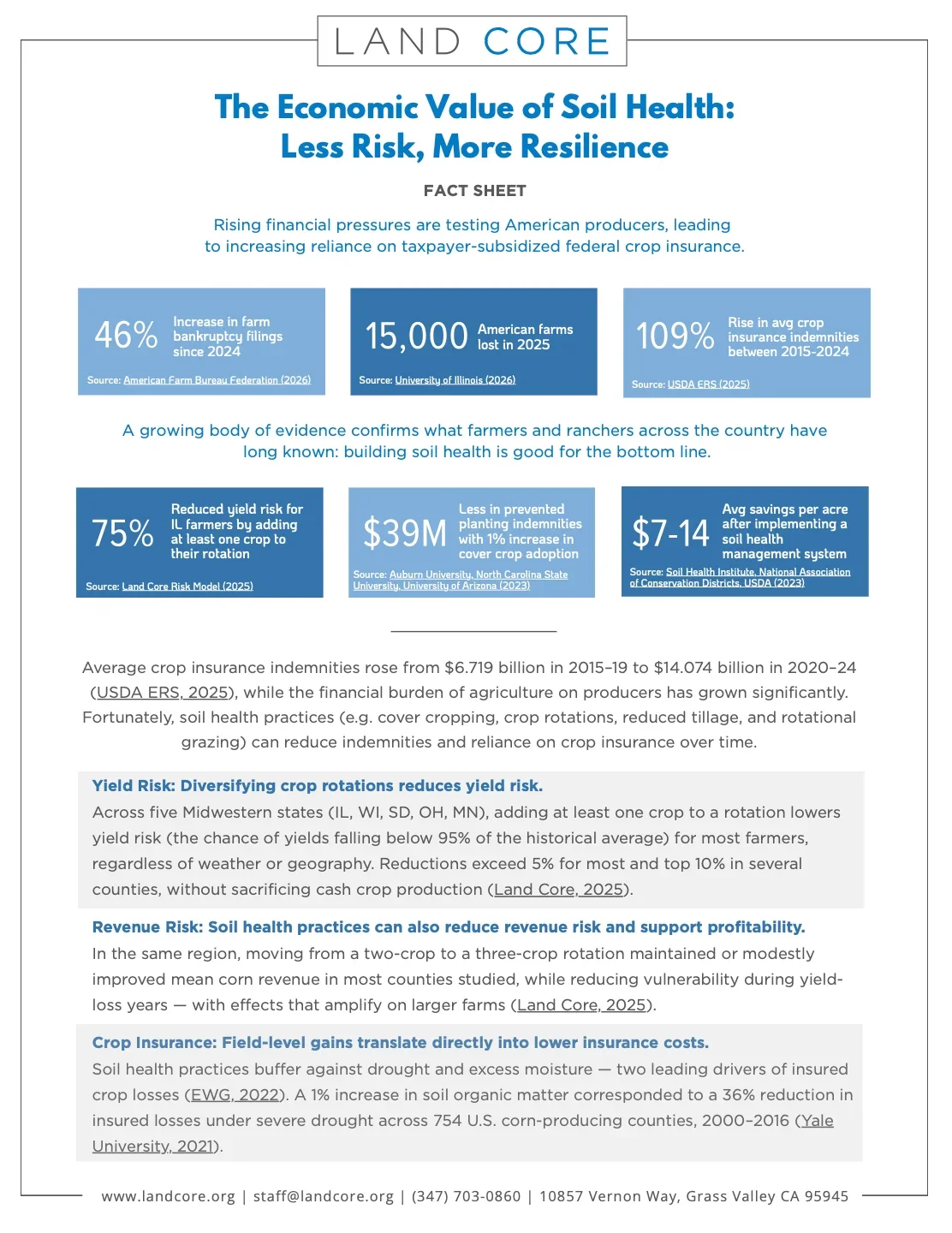
Check out our new 1-pager, which makes the case that soil health practices, including cover cropping, diversified rotations, reduced tillage, and rotational grazing, are one of the clearest, most cost-effective ways to reduce agricultural risk. Drawing on Land Core's own FFAR-funded research alongside findings from USDA and leading farm organizations and universities, the fact sheet shows how these practices lower yield risk, support revenue, and cut insurance costs for producers, lenders, insurers, and companies managing supply chain exposure alike.
Please share this resource with policymakers, producers, financial stakeholders, soil health advocates, and partners in your network. Reach out to our team if you’re interested in having us present these findings to your network and learning more about how soil health can reduce risk and increase resilience in our agricultural system.
Help Shape Land Core's Risk Reduction & Resiliency Policy Platform
The Land Core team is developing a policy platform focused on agricultural risk and resilience. It's intended to be a "north star" platform that can inform not only future Farm Bills but also a wider set of legislative and agency actions at both the federal and state levels.
In its final form, the platform will help stakeholders in agriculture and conservation understand and advance a set of innovative, cost-effective, pragmatic, and even bipartisan policy opportunities that create value for farmers, businesses, and communities. While there will be a heavy focus on federal crop insurance, we're also drawing on parallels and best practices from relevant industries like flood and fire insurance. This platform will be a companion to the fact sheet (above) and will build on Land Core's years of leadership in understanding how soil health impacts agricultural risk and resilience, and in identifying and advancing the opportunities inherent in quantifying and incentivizing risk-reducing practices.
We want to hear from you. As we build out this platform, we're looking for policies and programs that reduce risk for producers and strengthen resilience across the agricultural system. This could be a specific program you've seen work (or fail) firsthand, an idea you think we should be pushing for, or a lesson learned from crop insurance, flood insurance, fire insurance, or another risk-management field. If you have thoughts to share, reach out to us at staff@landcore.org. We'd love your input as we shape this platform.
Paper of the Month
Stages of farm profitability after soil health system adoption in Georgia cotton, Flanders et al., 2026, Agronomy Journal
A new study from the Soil Health Institute shows evidence of the long-term economic benefits of soil health management systems (SHMS) from Georgia cotton growers who had sustained reduced tillage and cover cropping for 5+ years. Researchers modeled net farm income as a sequence of five stages: reduced tillage, cover crops, reduced irrigation demand, reduced fertilizer/pesticide use, and increased yield.
The findings: while the earliest stages of adoption came with up-front costs, those costs were reversed as soil health benefits compounded. By Stage 4, reduced irrigation, fertilizer, and pesticide needs had already pushed net farm income positive, and by Stage 5, accounting for a measured yield increase of 81 kg/ha, sustained SHMS adoption produced a net farm income gain of $240 per hectare compared to conventional systems.
Check out what the Land Core Team is reading, watching, and listening to this summer!
It's been a big summer for farm policy and farm stories alike. To stay inspired and grounded in the work, the Land Core team pulled together a wide range of books, podcasts, films, and articles for your consideration.
The list includes everything from David Montgomery's case for regenerative farming as a public health strategy, to Michael Carter Jr.'s history of African-origin crops in American agriculture, and a handful of podcasts covering everything from regenerative finance to farm bill fights.
Opportunities/Funding
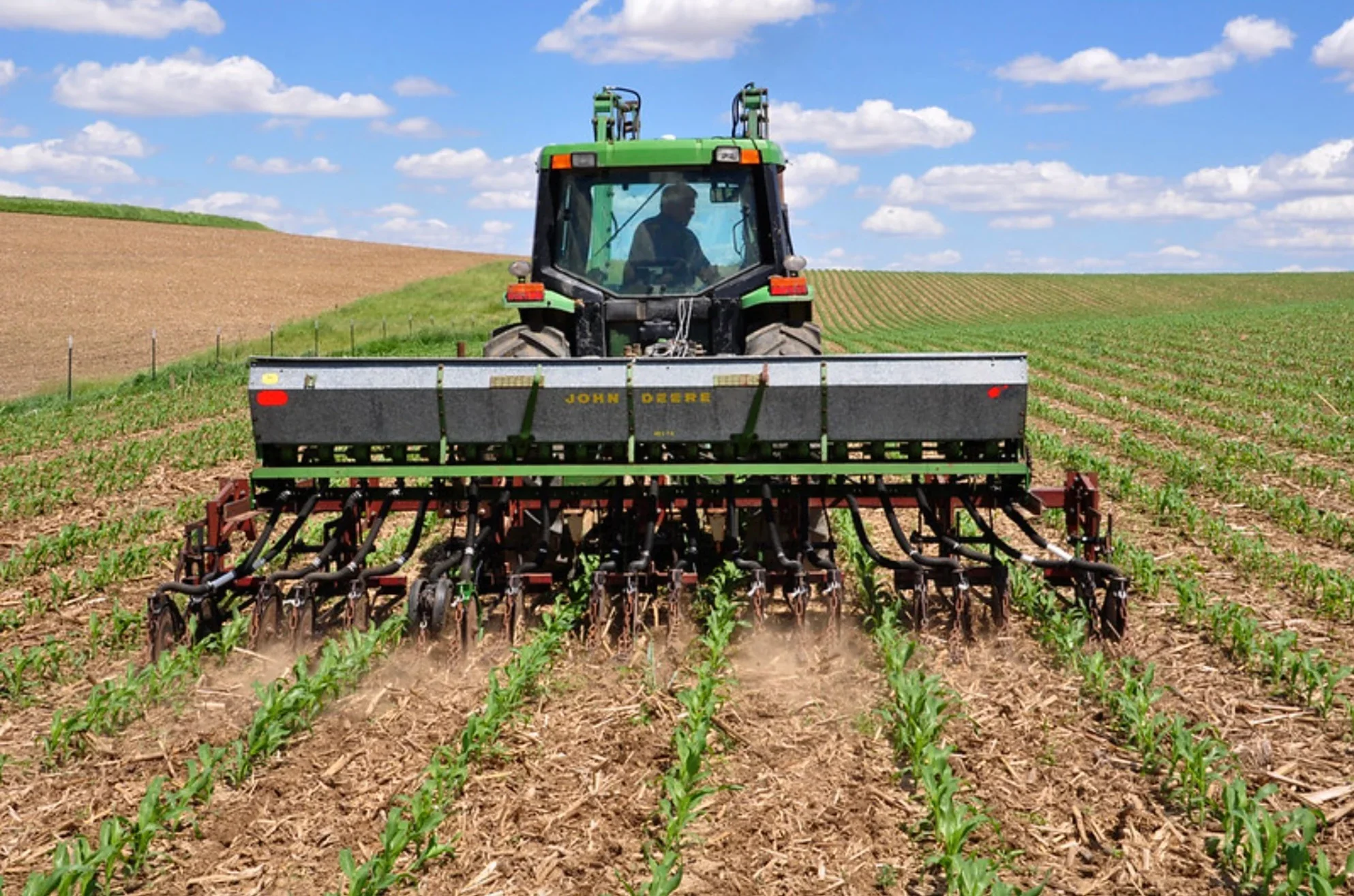
Image: NRCS/SWCS photo by Lynn Betts. Interseeding cover crops.
SARE: Northeast & West
Northeast SARE is accepting proposals for its Graduate Student Research Grant Program, which funds graduate student-led research on sustainable agriculture topics relevant to the Northeast, including soil quality, cropping systems, pest management, livestock health, and farm economics. Grants are capped at $30,000 and can support projects running up to two years. Applicants must be graduate students at an accredited college, university, or veterinary school, with their faculty advisor serving as the official principal investigator. Proposals are due Tuesday, September 29 by 4 pm ET.
Western SARE also has several grant programs currently open, including Graduate Student, Professional + Producer, Farmer/Rancher, Professional Development, and Local Education & Demonstration grants, most with an October 28, 2026 deadline (12 pm MT). A Visiting Research & Education grant is also open, with a deadline of October 5, 2026 (12 pm MT).
Boulder County Soil Health Initiative
Boulder County is offering up to $400,000 in grants to farmers and ranchers on private land who adopt soil health practices such as no- or reduced-tillage, cover cropping, and rotational grazing/crop rotation, in alignment with USDA soil health principles. Applicants must have operated a farm or ranch in Boulder County for at least two years and may submit one application. The application window is open now through August 24, 2026.
Upcoming Events
Image from Unsplash+.
August 22, 2026 - Perennial Farm Ecosystem Conference (Traverse City, MI): Hosted by the Grand Traverse Conservation District in partnership with MSU's Northwest Horticultural Research Station, this free, full-day event focuses on regenerative strategies for orchard and vineyard systems, soil health, biodiversity, pollinator habitat, and low-disturbance management. Learn more here.
August 29, 2026 - Rotational Grazing Workshop (Carnation, WA): Join the Livestock Team at Carnation Farms for a hands-on workshop designed to help homesteaders, farmers, and ranchers enhance their pastures, improve herd health, and implement regenerative rotational grazing practices. Whether you're new to grazing or refining an existing approach, the workshop offers practical tools, community support, and expert guidance. Register here.
September 20-27, 2026 - Climate Week NYC (New York, NY): Held alongside the UN General Assembly, Climate Week NYC brings together governments, businesses, investors, and civil society for a week of sessions on climate finance and resilience, including topics increasingly relevant to agriculture and food systems, from soil health to supply chain resilience. Explore the 2026 agenda and look for events labeled the pink “Food” theme tag. And don’t miss the Regen House ag programming.
September 25-27, 2026 - Prairie Festival 2026 (Salina, KS): The Land Institute celebrates its 50th anniversary with a weekend of speakers, perennial grain foods, artists, musicians, hands-on demonstrations, and more along the Smoky Hill River. Festival programming reflects on 50 years of work to transform food systems and envisions the next 50 years of the perennial agriculture movement. Learn more and register here.
October 7-8, 2026 - Regenerative Food Systems Investment (RFSI) Forum (Denver, CO): The premier gathering for investors, lenders, and food system leaders exploring how to deploy capital into resilient agriculture, RFSI brings together fund managers, banks, insurers, farmers, and researchers for sessions on farmland investing, blended capital stacks, and, notably, a dedicated discussion on modernizing agricultural risk data for finance and insurance. Learn more and register here.
October 28-30, 2026 - REGENERATE Conference (Santa Fe, NM + Virtual Options Available): Hosted by Quivira Coalition, Holistic Management International, and the American Grassfed Association, REGENERATE explores solutions for resilient working lands with workshops, roundtables, and community gatherings. Virtual attendance is available for plenary sessions (with Spanish translation), and discounted rates are offered for beginning agrarians, land stewards, and students. Learn more and register by 9/1 for early bird pricing.
What We're Reading
Land Core's monthly roundup of soil health and agriculture news
Image from Unsplash+.
California bans paraquat, highly toxic herbicide outlawed in more than 70 countries
California's Department of Pesticide Regulation canceled the state's last paraquat registration, making it the second U.S. state (after Vermont) to ban the herbicide, which public health advocates say is virtually proven to cause Parkinson's disease and has already been outlawed in over 70 countries. The move follows a 2024 state law requiring re-review of the pesticide's risks; rather than share updated safety data with regulators, manufacturer Syngenta withdrew its use permit and announced it would stop producing the chemical altogether.
By Tom Perkins, The Guardian, August 13, 2026
Reconciliation 3.0 Could Be Worse (and a Whole Lot Better)
This piece argues that the third reconciliation package of the 119th Congress, which includes roughly $11-12 billion in agricultural "economic assistance," represents an overreliance on reconciliation to bypass regular budget order, with few details on how committees will achieve the bill's long-term deficit reduction goals. Swift contends the House Agriculture Committee should target aid more efficiently after this year's $55 billion in farm subsidy payments went primarily to large operations rather than smaller producers.
By Nan Swift, R Street Institute, July 27, 2026
Senators Press USDA on Rural Development Reorganization
Senate Agriculture Committee Ranking Member Amy Klobuchar and 20 Senate colleagues sent a letter to USDA Deputy Secretary Stephen Vaden raising concerns that a planned reorganization, including a required relocation of 60% of National Capital Region staff to St. Louis or Dallas, would further deplete Rural Development's capacity after the mission area already lost 36% of its staff last year. The senators requested USDA respond by August 5 with staffing analyses, hiring plans, and details on how the agency will maintain service delivery to rural communities.
By Sen. Amy Klobuchar et al., July 24, 2026
MDARD Invests in Next Generation Crop Insurance Pilot for Michigan Farmers
Michigan's Department of Agriculture and Rural Development is funding a new crop insurance pilot that prices premiums based on farmers' use of soil health practices like cover cropping and reduced tillage, addressing what the coalition leading the pilot calls an outdated, backward-looking risk model. The $480,900 pilot launches for corn and soybean growers in four Michigan counties in 2027, with plans to expand to more states and crops as data comes in.
By MDARD Communications, July 21, 2026
Regenerative agriculture helps Western Slope farmers cope with the warmest winter on record
Aspen Public Radio profiles Colorado farmers who credit cover cropping and reduced tillage with helping them retain soil moisture through the state's lowest snowpack year on record, even as the practices can't fully offset losses from a historically dry, warm winter.
By Michael Fanelli, Aspen Public Radio, July 12, 2026