
Land Core Newsletter - July 2026
Image from Unsplash+.
Dear friends & colleagues,
It's been a busy month at Land Core and in the agriculture policy world. We submitted comments to BLM on their proposed grazing rule changes, and while we support certain elements, including increased flexibility for producers, we also advocate that any rule changes be tied to an outcomes-based, regenerative management framework. We also published our analysis of the Senate Farm Bill and its potential impact on soil health, and sent our quarterly Bill Tracker Alert, which breaks down newly introduced and reintroduced bills, movement on tracked legislation, and other highlights from this quarter, that could affect soil health.
We're also excited to share our newest resource: “The Economic Value of Soil Health: Less Risk, More Resilience”, a simple one-page fact sheet that lays out the data on how soil health practices reduce yield risk, support revenue stability, and lower crop insurance costs. Please share this resource with policymakers, producers, financial stakeholders, soil health advocates, and partners in your network.
Lastly, please join us in welcoming Maeve Goldberg to the Land Core team as our new Policy Associate! Learn more about Maeve below.
Read on for Farm Bill and USDA policy updates, funding opportunities, upcoming events, and what we're reading this month.
With gratitude,
The Land Core Team
New 1-Pager: “The Economic Value of Soil Health: Less Risk, More Resilience”
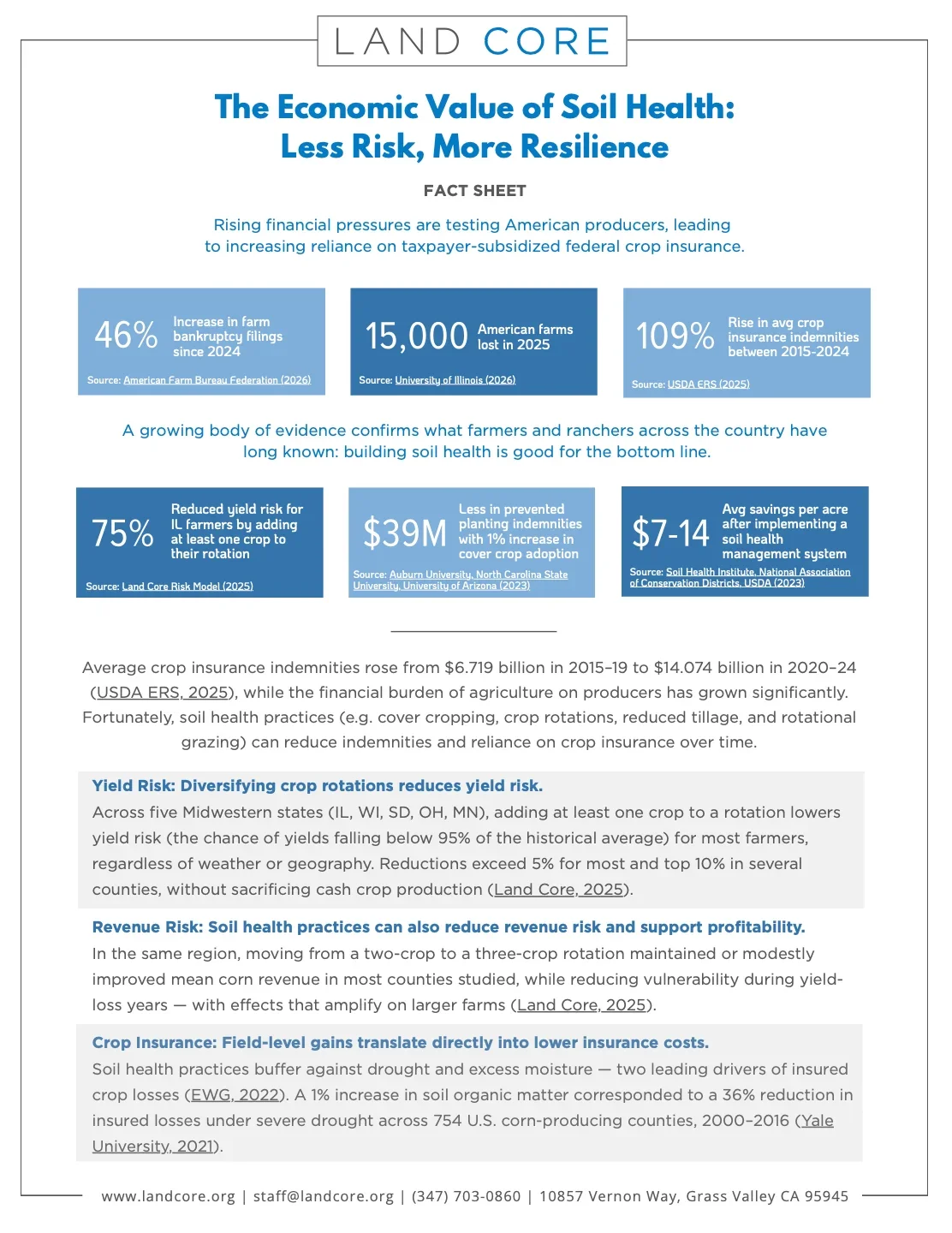
Land Core's new fact sheet, “The Economic Value of Soil Health: Less Risk, More Resilience,” makes the case that soil health practices are one of the clearest, most cost-effective levers for building resilience into our agricultural system.
Drawing on our own FFAR-funded risk modeling alongside research from leading universities, the fact sheet shares how soil health practices lower yield risk, support revenue stability, and translate directly into lower insurance costs.
Healthy soil isn't just good land stewardship. It's good economics.
Please share this resource with policymakers, producers, financial stakeholders, soil health advocates, and partners in your network.
Federal Policy Updates
Image from Unsplash+.
Land Core Comments on BLM Proposed Grazing Rule
In May, the BLM proposed an overhaul of its grazing regulations, with the stated goal of streamlining grazing administration. In our public comment, Land Core recommends a shift toward flexible, outcomes-based regenerative grazing management, and urges BLM to anchor rancher flexibility to verifiable soil health standards, preserve water quality as a fundamental of land health, and strengthen monitoring and training as assessments move to the landscape scale. We also raise concerns about the rule's narrowing of stakeholder consultation and its potential impact on Tribal-led bison restoration programs.
Senate Farm Bill Updates
Senate Agriculture Committee Chairman John Boozman (R-AR) released a discussion draft of the Agriculture Act of 2026 on June 23, following the House's passage of its own farm bill in April. A markup is expected before the Senate's August recess, though it hasn't yet been scheduled. Notably, the draft sidesteps prior sticking points in the House, like pesticide labeling and year-round E15, to preserve a bipartisan path to 60 votes, though it does not address Democrats' priority of delaying SNAP state cost-share requirements.
Read Land Core’s latest blog post for a title-by-title breakdown of the key provisions impacting soil health, including updates to conservation programs, research funding, and crop insurance, plus a look at what might be next for the bill as it heads towards a markup.
Congressional Budget Updates
The Farm Bill is one of several major items on Congress’s packed summer agenda, with the ongoing budget process absorbing much of its legislative bandwidth. House Republicans released a $95 billion budget framework on July 14 and have tied Iran-war-related defense funding, farm aid, and election-related provisions together. The budget resolution includes up to $12 billion for farm assistance, which could provide short-term financial relief for producers facing continued economic pressures. However, some lawmakers argue it falls short of the support needed to address declining farm income and rising production costs.
The House Agriculture Committee will be directed to debate and mark up legislation detailing how the $12 billion will be spent before sending it back to the Budget Committee to be folded into the broader reconciliation bill. A House floor vote on the underlying budget resolution could come as soon as today, though it faces a shaky path among Republicans in the House and a more difficult path in the Senate.
Trump Administration Regenerative Agriculture Executive Order and Regenerative Feedstock Rule
As many of you have now seen, on June 25, President Trump signed an executive order titled Advancing Regenerative Agriculture and Strengthening American Farm Resilience. The EO directs USDA to expand the Regenerative Pilot Program (announced in December 2025) and build public-private partnerships to increase capacity for farmers adopting regenerative practices. Alongside the executive order, USDA Secretary Brooke Rollins also finalized the Regenerative Feedstock Rule, which creates a voluntary framework connecting regenerative practices, including cover crops, reduced/no-till, and improved nutrient management, to premium biofuel markets.
🌾 Donate to Land Core! Support our programs to advance soil health in 2026 and beyond.
Welcome, Maeve!

We're excited to welcome Maeve Goldberg to Land Core as our new Policy Associate! A North Carolina native and UNC-Chapel Hill graduate in public policy and geography, Maeve brings hands-on experience in federal agriculture policy, including time with the House Ag Committee and MDC Rural Forward. Maeve is especially excited to contribute to Land Core’s work advancing soil health as a foundation for thriving rural communities. Learn more about Maeve and our team here.
Resource Worth Sharing: FARMWISE
For farmers and ranchers looking to strengthen their financial footing, Croatan Institute's FARMWISE Hub (Financial Agriculture Resources for Maximizing Wealth, Income Stability, and the Environment) is worth a look. The platform offers free online financial health courses, one-on-one coaching, and a curated library of USDA resources, including guidance on CSP, EQIP, and FSA loan assistance, all aimed at helping underserved producers build resilience and access wealth-building opportunities.
Opportunities/Funding
Image from Unsplash+.
SWCS Emerging Leaders Program
The Soil and Water Conservation Society is now accepting applications for its 2027 Emerging Leaders Program: a fully remote, year-long leadership development experience for early-career conservation professionals (anyone within their first five years post-grad). Participants get a full year of complimentary SWCS membership, mentorship, professional development training, and a spot at the SWCS International Annual Conference, all at no cost.
USDA Specialty Crop Assistance (ASCF) Program
USDA has announced enrollment for the Assistance for Specialty Crops Farmers (ASCF) program, which will issue $1.625 billion in payments to eligible specialty crop producers facing elevated input costs and trade-related market disruptions from the 2025 growing season. Producers with a Login.gov account can access pre-filled applications starting June 1, 2026; those without can request applications at their local FSA office beginning June 8. The enrollment window closes August 7, 2026.
USDA Supplemental Disaster Relief Program (SDRP), Deadline Extended
USDA has issued a second round of Supplemental Disaster Relief Program (SDRP) payments and extended the application deadline from April 30 to August 12, 2026, giving producers more time to address application changes. The program covers eligible crop, tree, bush, and vine losses from qualifying natural disasters (drought, flooding, wildfire, freeze, and related events) in 2023 and 2024.
Paper of the Month
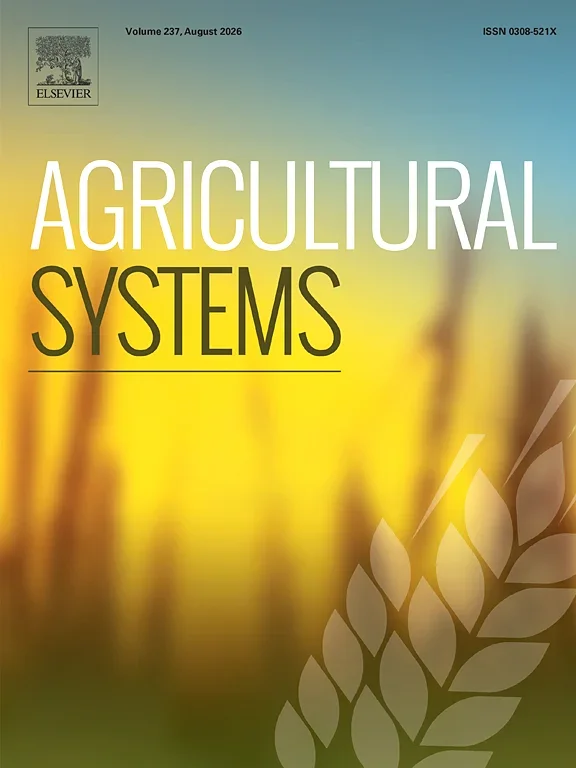
A new study from MSU researchers offers rare, decade-scale evidence on how grazing management affects the soil carbon and GHG footprint of beef production. Using 11 years of on-farm data from an experimental Michigan research site, the team compared two adaptive multi-paddock (AMP) grazing systems (one fully grass-finished, one transitioning to a feedlot), tracking both soil carbon accrual and lifecycle emissions.
The findings: soil organic carbon in AMP-grazed pastures increased at a conservative rate of 0.52 Mg C per hectare per year over the study period, roughly 1.5-2x higher than commonly cited rates for improved grazing management. Factoring that carbon gain into the full lifecycle assessment cut net GHG emissions by 41% for the grass-finished system and 34% for the feedlot-finished system, while maintaining beef output comparable to conventional regional systems.
The authors are careful to note that their assumptions were intentionally conservative on both ends: a cautious soil carbon baseline and methane estimate that likely overstates emissions, meaning the true mitigation potential may be even greater than reported.

Upcoming Events
July 26-29, 2026 - 81st SWCS International Annual Conference - (St. Louis, Missouri)
The Soil and Water Conservation Society's flagship annual gathering brings together conservationists, researchers, and producers from around the world. Land Core's Co-Founder and Executive Director, Aria McLauchlan, will be presenting on recent revenue risk findings from our soil health risk modeling research. Learn more →
Aug. 4-6, 2026 - Crops & Cattle Conference & Ag Expo - (Kansas City, Missouri)
A High Plains Journal event covering crop and cattle management, water conservation and soil health, and practical profitability strategies for producers across the 12-state region the publication serves. Learn more →
Aug. 13, 2026 - New York Soil Health Field Day - (Seneca Falls, New York)
Featuring Indiana no-till/regenerative farmer Rick Clark and Cornell soil scientist Dr. Harold van Es, this field day combines on-farm demonstrations with the latest soil health research. Learn more →
Aug. 20-21, 2026 - Bottom Line Conference - (Lakin, Kansas)
A coalition of nine county conservation districts hosts this two-day event on soil health and water conservation strategies for dry-climate farming and ranching. Learn more →
Aug. 22, 2026 - Perennial Farm Ecosystem Conference - (Traverse City, Michigan)
A free, full-day conference on regenerative agriculture strategies for orchard and vineyard systems, hosted by the Grand Traverse Conservation District and MSU's Northwest Horticultural Research Station. Featured topics include soil microbiology, orchard floor management, and building crop resilience through soil health. Learn more →
What We're Reading
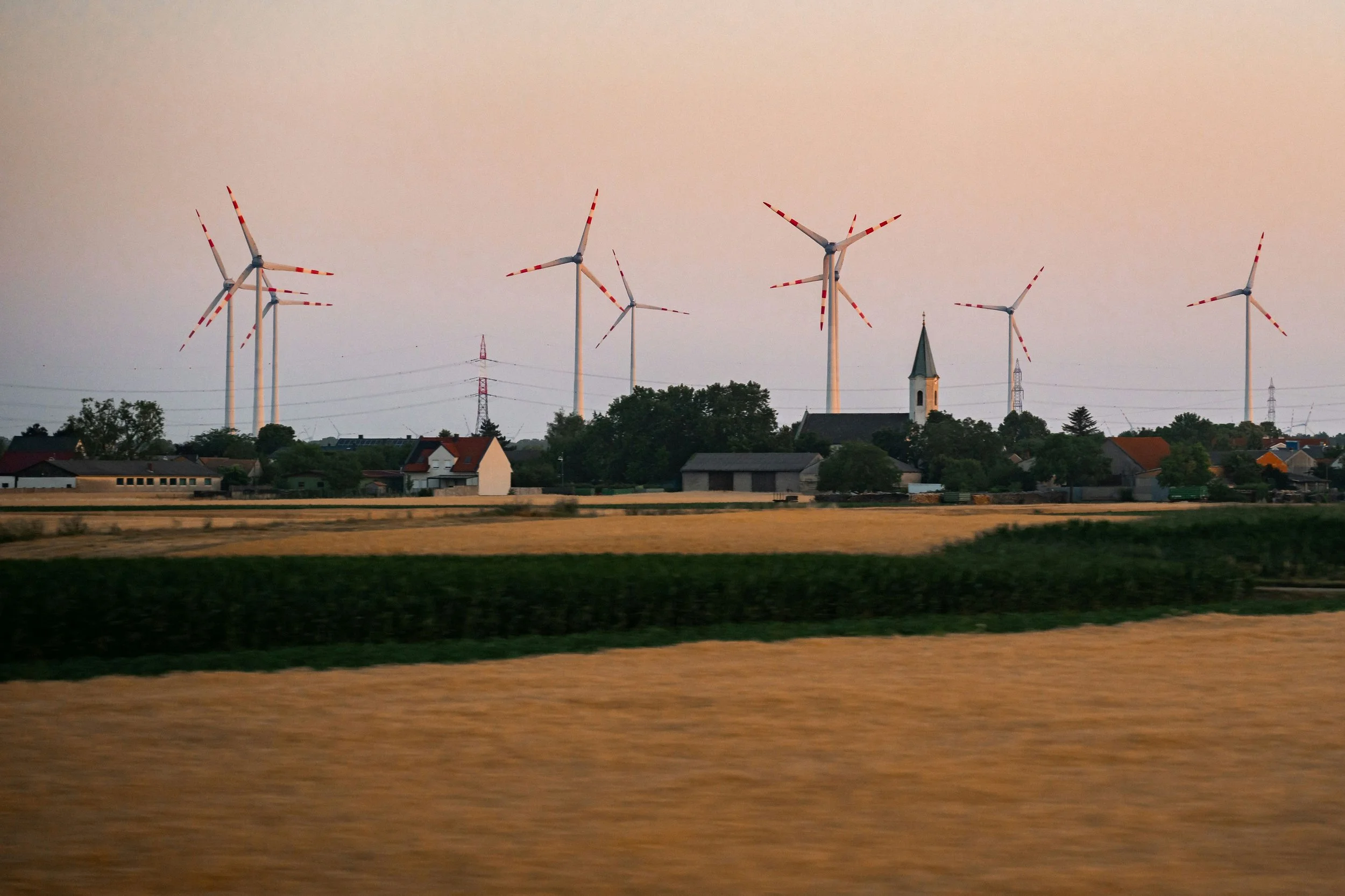
Image from Unsplash+.
Regenerative Agriculture Is Firmly Rooted Across America
USDA data shows “regenerative practices” like grazing management, cover crops, and nutrient management have grown significantly over the past decade, with enrolled acres rising more than 360% between fiscal years 2014 and 2023. In this piece, Farm Bureau acknowledges the momentum around regenerative agriculture, while seeking to frame USDA's new $700 million Regenerative Pilot Program as building on a shift already well underway among American farmers and ranchers.
By John Newton, Ph.D., American Farm Bureau Federation, July 14, 2026
For 41 years in a row, USDA sent taxpayer-funded payouts to roughly 9,000 farmers, totaling $10.6B
New EWG analysis finds that nearly 9,000 farm operations collected federal subsidy or disaster payments every single year between 1985 and 2025, totaling $10.6 billion, with the top 10 recipients each collecting between $9 million and $22 million over that period. The piece argues that recent policy changes will deepen reliance on subsidies among the largest operations, even as small and mid-size farms face rising bankruptcy risk.
By Jared Hayes, EWG, July 13, 2026
The Commodity Credit Corporation, Charter Act Authority, and Congressional Primacy over Spending
This report argues that the Commodity Credit Corporation's Charter Act gives the Secretary of Agriculture broad discretionary power to create farm subsidy programs, including the recent $11 billion Farmer Bridge Assistance Program and $1.625 billion specialty crop program, without congressional appropriation or oversight. The author contends that proposals to raise the CCC's $30 billion borrowing limit would further shift agricultural policymaking away from the farm bill process and Congress's constitutional power.
By Joshua Sewell, American Enterprise Institute, July 15, 2026
'City slicker' payments swell to $2.6B with Trump's Big Beautiful Bill and farm bailouts
A new EWG analysis finds that more than 92,000 residents of major U.S. metro areas collected over $2.6 billion in farm subsidies between 2020 and 2025, despite many having no direct connection to farming. The piece ties this to recent policy changes that raised per-person payment limits and expanded eligibility loopholes for pass-through business entities.
By Jared Hayes, Environmental Working Group, July 9, 2026
'If there's no fertility, there are no farms': Why big food is exploring regenerative agriculture
The piece profiles Soil Capital, a company that pays farmers to adopt regenerative practices and sells resulting carbon certificates to corporate partners like Nestlé, which aims to source half its key ingredients from regenerative farms by 2030. It also surfaces a notable counterpoint: WRI's Timothy Searchinger argues soil carbon sequestration on working farmland is unlikely to meaningfully offset climate emissions, even as he agrees the practices improve erosion control and water retention.
By Jasmin Sykes, CNN Business, June 19, 2026
A new survey from nonprofit Kiss the Ground finds consumer awareness of "regenerative agriculture" grew from 7% to 13% over the past year, and has more than tripled since 2023. Notably, the survey found consumers are motivated more by personal health and nutrient density than environmental concerns when buying regenerative products, with price cited as a barrier by only 12% of respondents.
By Andrew Watman, Forbes, June 18, 2026
Avoid these common pitfalls when considering regenerative ag
Indiana farmer Joe Hamilton shares lessons from transitioning his operation to no-till and cover crops since 2015, covering practical hurdles like managing nitrogen tie-up from high-biomass cover crops, retrofitting planter equipment, and building flexibility into cropping plans for factors outside a farmer's control.
By Allison Lynch, Indiana Prairie Farmer/Farm Progress, June 16, 2026
New research from the University of Georgia and University of Missouri identifies 14 distinct farmer "mindsets" toward cover crops across the Northeast, Southeast, and Midwest, finding that adopters and nonadopters often share the same underlying values, meaning one-size-fits-all outreach campaigns may be missing the mark.
By Maria Teresa Tancredi, Robert L. Myers, Nicholas Tuschak Basinger, and Jennifer Jo Thompson, Journal of Soil and Water Conservation, June 11, 2026