
News Archive
2025

Connect with us at one of these upcoming events!
Without a doubt, 2025 will be one for the record books—bringing enormous changes, from the scope and scale of government policies impacting farmers to the emergence of soil health as a focus at the Department of Health and Human Services (HHS), as well as regenerative agriculture becoming more widely recognized and incorporated into USDA conservation initiatives. Between shifting trade dynamics, the growth of Food as Medicine initiatives, and the release of several groundbreaking studies on the economic benefits of soil health, it was a pivotal year.

Dear friends and colleagues,
As we’ve progressed toward the end of the calendar year, Congress continued to introduce (and reintroduce) a range of agricultural bills with implications for soil health. While the longest government shutdown in U.S. history slowed the regularity of presented legislation in October and November, as evidenced by the number of new marker bills introduced in this area, bipartisan support for soil health-focused legislation remains consistent.
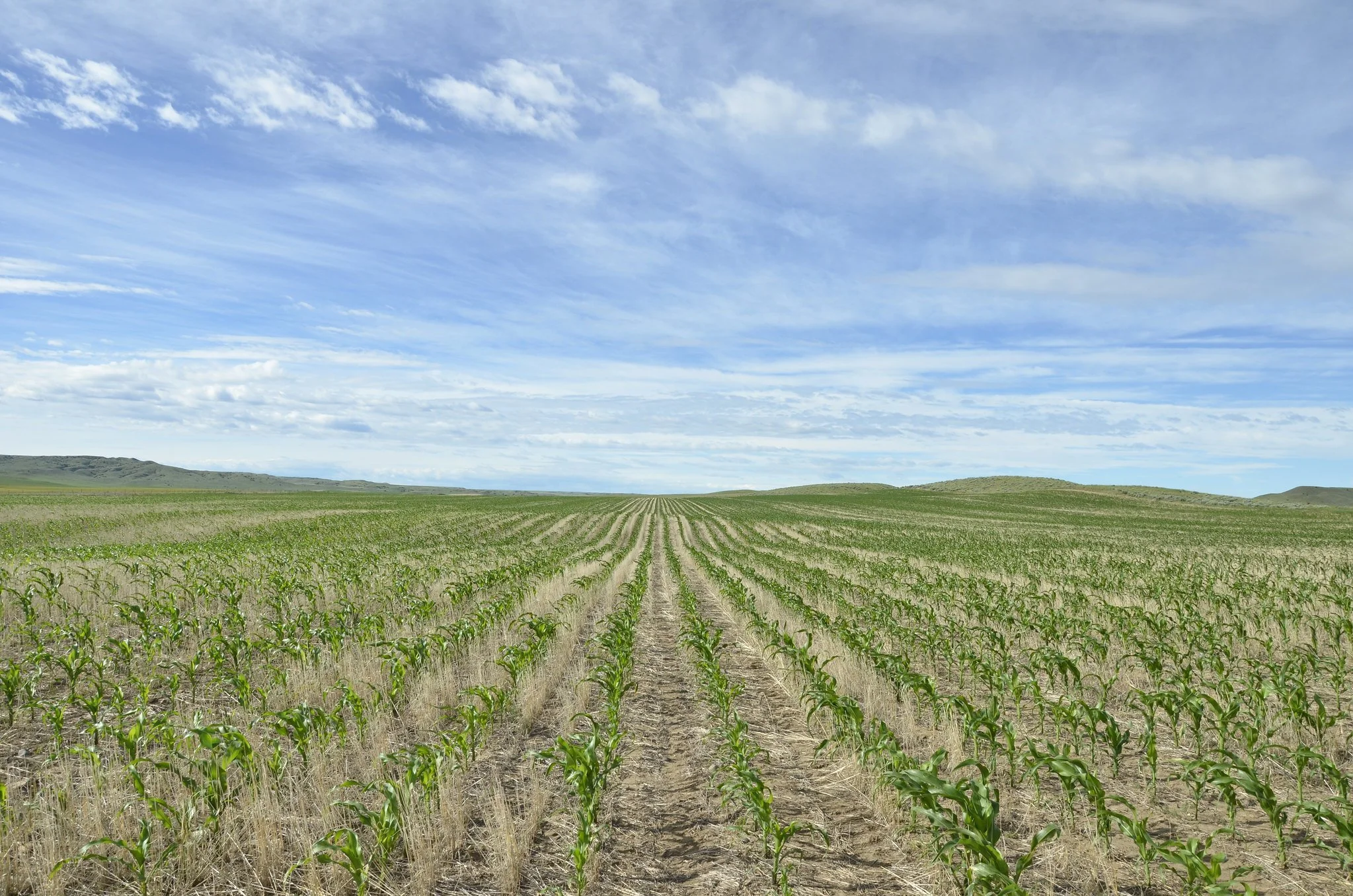
Land Core is pleased to share findings from a recently released paper by Dr. Gina Pizzo, which directly informs our ongoing risk modeling work, and was written as part of our FFAR and USDA AFRI-funded project examining how soil health practices reduce risk.
The research summarized below advances Land Core’s ongoing work to quantify how known soil health practices build resilience in agricultural systems.
Following the longest shutdown in the history of the United States federal government, a long-awaited and highly debated funding package, the Continuing Appropriations, Agriculture, Legislative Branch, Military Construction and Veterans Affairs, and Extensions Act, 2026, was signed into law on November 12, 2025.
The legislation provides a full year of agriculture and FDA funding for FY26 Appropriations, along with a one-year extension of the 2018 Farm Bill, in lieu of the long-overdue five-year farm bill. The bill makes significant funding adjustments for key agricultural agencies and programs, many at lower levels than Land Core’s prior recommendations to strengthen support for soil health.
Dear friends and colleagues,
Throughout the summer, Congress continued to introduce (and reintroduce) a variety of agricultural legislation with both direct and indirect implications for soil health. While tensions between political parties grew following the signing of President Trump’s One Big Beautiful Bill into law on July 4, 2025, bipartisan efforts to advance soil health-focused legislation remained ongoing.

Land Core previously identified four key policy recommendations in response to the Make Our Children Healthy Again: Assessment released on May 22, 2025. We noted that any public policy to address the chronic disease crisis and increasing nutrition insecurity should consider the soil from which food is grown.

Dear friends & colleagues,
Summer is a powerful reminder of the vitality and abundance that soil health brings to our landscapes and communities. During this time, the Land Core team has had the privilege of visiting partner farms that exemplify the transformative power of working with nature.
From the thriving, vertically-integrated systems of White Oak Pastures to the verdant fields of Matt Rales and Abigail Fuller’s new ranch in Ashland Oregon, our travels have taken us to the heart of soil health practices in action this month. These pioneering land stewards are more than just farmers, they are leading voices in a growing soil centered movement.

The connection between soil health and human health plays a pivotal, but often overlooked role in a wide variety of systemic health problems. A robust and growing body of evidence shows that biologically active, nutrient-rich soils yield more nutrient-dense foods, optimally supporting human health and development, while simultaneously building resilient food production systems. Any public policy to address the chronic disease crisis and increasing nutrition insecurity should consider the soil from which food is grown.

The reconciliation bill, which includes major changes to spending, taxation and the national deficit, also makes major adjustments to agriculture policy and programs, with the Congressional Budget Office estimating an additional $66 billion increase in farm program spending over 10 years.

Soil health, storytelling, and summer inspiration from the Land Core team
Looking to add to your summer reading (and watching) list? Here’s what’s been catching our attention lately—from a documentary you can watch with your family, to recent research on nitrogen use efficiency.

The 119th Congress has continued to introduce (and re-introduce) a range of agricultural legislation with both direct and indirect implications for soil health. While the overall pace of bill introductions has moderated slightly, there is evidence of growing momentum around shared priorities such as strengthening the resilience of farming communities and expanding economic opportunities for farmers through the expansion of precision agriculture and conservation practices.

Dear friends and colleagues,
June is upon us, and with it, the height of the growing season. It’s also the season of the garden, a time when those of us not working the land professionally may still find our hands in the soil, coaxing seedlings to life, navigating the quiet persistence of weeds, and confronting inevitable pests. In these small acts, we encounter, however briefly, a glimpse of the daily complexities farmers manage on a vastly different scale.
While a home garden may offer personal fulfillment or a few nourishing meals, it is important to remember that our farmers face the challenges you might have at home (along with so many others)… and across thousands of acres, with far higher stakes. They feed our communities, anchor rural economies, and steward the vast landscapes on which we all depend. That’s why Land Core remains steadfast in advancing soil health policy creating durable value not only for farmers, but for businesses, communities, and the ecosystems they inhabit.

Dear friends and colleagues,
The team at Land Core has been actively monitoring legislative developments from the 119th Congress, with reconciliation and its impact on critical agricultural programs at the forefront. While a variety of proposals have emerged, the path forward still remains complex. Nevertheless, we remain hopeful that some progress will be made to support soil health priorities.
Internally, we are continuing our outreach to congressional members interested in advancing soil health practices to help farmers build farm resilience and access greater economic opportunities in the process.

At Land Core, we understand that healthy soil is more than an agricultural asset—it’s also a public health imperative. While our work has long emphasized the critical role of soil in building resilience and agricultural viability for our producers, we are equally clear that it plays a foundational role in supporting the health of our communities.
It’s been a very busy year thus far, with our team adding many new bills and several pieces of reintroduced legislation from the previous Congress. This indicates not only continued support for soil health but a commitment to carry over and continue the groundwork laid in preparation for the overdue Farm Bill.

Explore the archive of our bill tracker alerts, which provide regular updates on soil health legislation in Congress.

Dear friends and colleagues,
Happy Spring!
Last month was a busy one. In addition to speaking engagements and conferences, Executive Director Aria Mclauchlan also traveled to Washington to meet with legislative offices, working to advance key Land Core priorities for the year. While news from DC can sometimes feel overwhelming, there are still consistent opportunities to champion soil health by highlighting the economic benefits for farmers, producers, and taxpayers alike.

As in-person and online activities ramp up for the year, we’re excited to be re-engaging with colleagues, policymakers, and coalitions to share the developments of our policy work as well as the Risk Model Project.

Co-founders Aria McLaughlin and Harley Cross sit down with Page Mitchum for “Regenerating America: How Policy Shapes Our Plates”.

The year is back in full swing here for the Land Core team as we set our sights on new opportunities within the current administration to advance soil health practices, programs, and policies. We’ve been closely following cabinet nomination hearings and recent confirmations, preparing outreach to new appointees and stakeholders who share our mission of creating value for farmers, businesses, and communities.

Land Core will be expanding its engagement with HHS in the years ahead, supporting the individuals and institutions working to ensure that this emerging soil-centered vision is meaningfully implemented. The potential to reshape national health outcomes through improved food systems grounded in soil health is significant and deserves serious attention.

In 2025, with a new administration and Congress, Land Core remains focused on the unifying goal that soil is our common ground. We are looking forward to working with stakeholders across the country to unlock greater long term, systemic protections for farmers and ranchers against volatility and extreme weather events, ensuring the stability of American agriculture long into the future.

Although Land Core is focused specifically on the soil health and the importance of supporting US agriculture in ensuring that we have the ability to independently grow the healthy foods, fibers, and fuels that we need to thrive as a nation, there is an undeniable correlation between the crops grown in healthy soils (vs degraded soils) and the health and well-being of those who consume them.
2024
Explore the archive of our bill tracker alerts, which provide regular updates on soil health legislation in Congress.

It’s with pride and gratitude that we look back and take stock on another momentous year for soil health. Although political deadlock in 2024 pushed the Farm Bill out another year, there is no denying that on the issue of soil health, we saw an exceptional year of growth, including unprecedented bipartisan support for federal policies, as well as increased adoption of soil health practices on farms and ranches across the country.

Land Core is pleased to provide input on NRCS’s commitment to improving Conservation Practice Standards (CPS). The comments address Soil Carbon Amendment; Herbaceous Weed Treatment; Nutrient Management; and Prescribed Burning. Detailed recommendations are also made regarding the need for increased technical assistance, and for innovative practices, such as incorporating data about the risk-reducing benefits of soil health practices into farm credit and crop insurance programs.

Here is a high-level list of policies that the incoming administration could implement at HHS to advance soil health as a foundational vehicle in the pursuit of human health. The policies are streamlined to highlight key initiatives and combined actions across agencies for maximum effectiveness.
We are inspired everyday by the potential of healthy soils. From healthier food and cleaner water, to creating more resilient farms that can better weather floods or drought, soil is the key to a thriving future. At Land Core, we’re fueled by the conviction that rebuilding our nation’s soils will foster resilience and profitability of US agriculture and strengthen our communities more broadly.

Soil health is the foundation for national food security. It is the bedrock of American public health and the key to the integrity and reliability of our country’s food system. Healthy soils are a vital path to resilience and prosperity for American producers.
The following recommendations have been designed to provide specific guidance to the incoming presidential administration and focuses on high-level, actionable priorities for key agencies across the federal government to advance soil health.

Many of you know that Harley and I co-founded Land Core in January of 2017, fueled by the conviction that building our nation’s soil health could help expand the resilience and profitability of US agriculture and strengthen our communities more broadly.

We hope you’re having an excellent end of summer, and are looking forward to the fall. Given the roller coaster of politics we are all on with this election season, some policy work is on pause, waiting to see how things shake out. That said, we are still tracking Farm Bill & Ag Appropriations news, submitting comments on agency actions like input on the 2027 Census of Agriculture to USDA NASS, and engaging in strategic planning to ensure soil health is recognized, valued and advanced across a wider breadth of agencies at USDA and beyond.

The U.S. Department of Agriculture’s National Agricultural Statistics Services (NASS) recently requested information for content requests for the 2027 Census of Agriculture.
Land Core submitted comments and recommendations, building on the organization’s leadership around the importance of soil health practices and their ability to provide subsequent risk reduction, economic, and environmental benefits.
While there hasn’t been as much Farm Bill activity recently, the House and Senate Ag-FDA Appropriations bills both passed and await floor time — we’ve added these to our Federal Bill Tracker and outlined below. We’ve also continued to track Core Soil Health bills introduced since the beginning of the summer.

We hope you had a fun and safe Fourth of July holiday! Land Core was back in DC this month for a busy week of meetings on the Hill continuing to focus on soil health as a central need for US agriculture. We also hosted our first virtual informational session about the Soil Health Risk Model and accompanying online tool for policymakers! Additionally, Land Core recently submitted comments to USDA based on a Request for Information about biofuel feedstocks.

The U.S. Department of Agriculture recently sought public input on “Procedures for Quantification, Reporting, and Verification of Greenhouse Gas Emissions Associated With the Production of Domestic Agricultural Commodities Used as Biofuel Feedstocks.” Land Core submitted comments and recommendations, building on the organization’s leadership around the importance of consistent outcomes verification protocols in soil health (and related GHG) measurement, monitoring and reporting. The recommendations also weigh in on the diversity of crops that can be used for biofuels feedstocks while building soil health, and soil health practices that should be considered by USDA.

We hope your summer is off to a good start! In the past month there has been more Farm Bill activity, including the release of the Senate Ag Minority leadership framework. The House Appropriations Committee also released the Ag-FDA spending bill and held a markup. Below you can find an overview of this recent activity, as well as a summary of our latest Federal Bill Tracker alert, including some new tracker features!

Land Core commends the U.S. Department of Agriculture (USDA) for building upon the Growing Climate Solutions Act (GCSA) of 2021. The Department’s leadership on this topic sends an important signal to the agricultural community. We appreciated the opportunity to provide input on the proposed framework.
The last few months have seen a flurry of activity, as the House Agriculture Committee released their full Farm Bill text, and the Senate Agriculture Majority and Minority leaders both released summaries of their Farm Bill proposals.
It has been another busy month here! Let’s start with an overview of some significant political activity. Following the release of a detailed Farm Bill proposal by the Senate Agriculture Committee earlier this month, the House Farm Bill was introduced on the 17th and went through markup on the 23rd, including some progress on our SOIL HEALTH Practices bill, which is now officially on the record for consideration in the final farm bill!
We have quite a bit of news to share from this past month! First, Farm Bill proposals are (finally) being released, which is creating renewed momentum and opportunity. Below, we've provided an overview of the Senate and House versions of the bill, as well as Land Core's soil health-related priorities that were included in the Senate leadership bill. We’re also pleased to share our recently submitted FY25 Agriculture Appropriations request.
The beta version of the online, interactive Risk Model Soil Health Tool is now available! The development of this tool would not have been possible without the brilliant team from the Schmidt Center for Data Science and the Environment (DSE) at the University of California, Berkeley.

By supporting voluntary financial incentives that complement existing conservation programs, farmers can be encouraged to adopt practices that prioritize soil health and long-term sustainability… We urge Congress to prioritize the following report language and program requests for the U.S. Department of Agriculture in FY25.

We're thrilled to share that our team’s first academic manuscript, titled “Diversified crop rotations mitigate agricultural losses from dry weather,” has been submitted for peer review! In the meantime, the "pre-print" manuscript is available on agriRxiv.

Happy Spring! Land Core recently spent National Agriculture Week (March 17-23) in DC discussing soil health legislation and ag-appropriations priorities. How did you celebrate National Agriculture Week? Send us an email or tag us in your posts to let us know!
In the past month, little movement has occurred on the Farm Bill. In the Senate, Senators Debbie Stabenow (chair) and John Boozman (ranking member) have publicly expressed that they are still negotiating key aspects of the Farm Bill and don’t expect to release a draft until after the 2024 Presidential Election in November.

It's been another busy month here at Land Core. With a recent trip to DC, uncertainty around the Farm Bill, and the upcoming National Ag Week in March, we've been heads down with policy and advocacy work. We have also shared some takeaways from the recent House Agriculture Committee hearing and the 2022 USDA Census of Agriculture.
We hope you are having a great start to the new year! 2023 was pretty momentous for Land Core and the soil health movement in general. In case you missed it, we are excited to share highlights from this past year, and our goals for 2024, in our year-in-review which you can find below. That said, the Farm Bill, which will set the legislative framework for the next five years of US agriculture, is still in limbo. While farm groups advocate for the importance of a bipartisan Farm Bill to be passed prior to the ramp up of this year’s general election, there is also the need for continued outreach for other top soil health priorities.
2023
Explore the archive of our bill tracker alerts, which provide regular updates on soil health legislation in Congress.

Happy New Year! We are pleased to share Land Core’s 2023 year-in-review, highlighting organizational accomplishments and progress for the soil health movement. We are immensely grateful to all the farmers, partners, coalition groups, and funders who make this work possible, and we look forward to all 2024 has to offer.
We added 9 bills in October and 14 in November to the Soil Health Bill Tracker. For bills introduced prior to October, 39 bills added at least one co-sponsor, showing that those bills have traction and support as we near the introduction of the Farm Bill.
As the holiday season kicks off, we are reminded of how thankful we are to be able to do this work and to do it alongside such a remarkable community of friends, farmers and colleagues. As a relatively small organization, your presence here is incredibly meaningful to us and your support has been critical in advancing our mission and goals.

Fall may be winding down but there’s been no shortage of activity here at Land Core. This past month has been full of policy and educational work, including a trip to DC to meet with policymakers to discuss ways to support the expansion of soil health in the upcoming farm bill, and to share, for the first time, our promising, preliminary findings from the risk model!
The Land Core Risk Model is quantifying the economic risk-mitigation value of specific soil health practices by examining the correlation between the implementation of these practices over time and their impact on yield.
Despite the August recess, we still added 30 “Core” soil health marker bills to the Bill Tracker and dozens more “Secondary” bills.
Pilot programs are exploring the opportunity to offer farmers improved financing terms based on their adoption of regenerative agriculture. The goal is to bring an expanded scale via financial incentives structured differently than dollars per acre for adoption.
As the fall season kicks off, we’re happy to share an update from the annual Regenerative Food Systems Investment Forum in Denver, CO, where a network of investors, philanthropists, farmers, “capital activators” and NGO support groups gathered to discuss and advance new flows of capital to support producers in adopting soil health practices and advancing more resilient or regenerative agricultural systems.

We hope you all had a great summer! The Land Core team, as well as our risk model partners, have been working hard on a number of items. This past month has seen a lot of press and some exciting new developments with the risk model tool, as well as a huge influx of new bills introduced in the 118th Congress hoping to make it into the Farm Bill. We have a fantastic new Land Core team member that we are excited to introduce to you, as well as two postdoctoral research associate positions that we are still looking to fill as we continue to grow our work. Read on to learn more!
With the Farm Bill fast-approaching (and the FY24 Appropriations and Senate Ag Committee Farm Bill request deadlines just behind us), members of the 118th Congress have been hard at work introducing in the last few weeks.

Land Core commends the U.S. Department of Agriculture (USDA) for proposing a framework for measurement, monitoring, reporting, and verification (MMRV) of greenhouse gas (GHG) emissions for the agriculture and forest sectors.

Insurers offer discounts for avoiding smoking and good driving because these practices are proven to mitigate risk and save them money. So should insurers and agricultural lenders offer farmers that look after their soil a ‘good soil discount’?
It has been another month of major activity here at Land Core. We have seen nearly 40 bills introduced this month that we are in the process of adding to our Soil Health Bill Tracker, we have begun expanding our work with Schmidt Center for Data Science and the Environment (DSE), and we have more truly excellent news on the Land Core Risk Model. So without further ado, enjoy this joyful update for July!
Researchers with the University of Arkansas System Division of Agriculture are conducting research examining soil health practices and their impacts on crop risk insurance premiums and other financial factors often faced by farmers. Lawson Connor, an agriculture economist for the Division of Agriculture, is the primary investigator for Arkansas’ involvement in the research. He is joined by researchers from U.C. Berkley and Rice University.

Ever since the federal government created the Soil Conservation Service following the Dust Bowl, the correlation between soil health and agricultural resilience has been generally well understood. However, almost a century later, we’re still struggling to accurately quantify how specific soil health practices reduce production risks. As a result, these practices remain largely unaccounted for in risk pricing models across finance, investment and insurance, and farmers are not compensated through financial discounts for adopting them.
With the Farm Bill fast-approaching (and the FY24 Appropriations and Senate Ag Committee Farm Bill request deadlines just behind us), members of the 118th Congress have been hard at work introducing in the last few weeks.
Land Core is pleased to provide input on the Bureau of Land Management’s (BLM) proposed Conservation and Landscape Health rule. Our comments elaborate on how and why the BLM might acknowledge and incentivize the opportunity to use the best standards for well-managed grazing for landscape restoration in partnership with ranchers, creating not only a win-win for the agency, ranchers, and national food security, but also a blueprint for the future of public-private partnerships in the pursuit of economically beneficial conservation.

As Summer heats up, we’re excited about all of the opportunities (see below) emerging to further the mission of expanding the scope and scale of soil health-focused agriculture in the US. We hope you will join us in raising awareness and sharing the momentum building in the lead up to the Farm Bill!

We are thrilled to announce that the Foundation for Food & Agriculture Research (FFAR) is awarding a $715,611 Seeding Solutions grant to Land Core to create an unprecedented market-based, actuarially-sound model that can determine the risk-mitigation benefits and related cost savings associated with specific soil health practices. Family foundations are providing matching funds for a total $1,449,611 investment. The model is helping to create the economic rationale for agricultural lenders and insurers to offer financial incentives, such as better terms or lower loan rates and insurance prices to producers adopting good soil health practices.
Today, Land Core, along with a diverse group of 170 farms, businesses, and organizations, submitted a letter to Congressional Agriculture Committee leadership in support of the DEFER Act and its inclusion in the 2023 Farm Bill.

Sign on deadline for the DEFER Act (one of our top Farm Bill priorities) extended to Monday, June 5 - join over 155 farming groups, businesses, and nonprofit orgs in supporting access to credit for conservation. Sign (or share) the letter of support! Read on for more updates, hiring opportunities, educational events and more.
We’ve had a busy and very successful spring so far, and it’s only just getting started! We are happy to report that several of the policies that we’ve helped shape over the last year have been included as priorities for the 2023 Farm Bill by members of the Senate Ag committee. Read on for sign on letters, updates on additional policies, job opportunities, and more.

As lawmakers consider the array of new federal policies, programs, and incentives aimed at facilitating these new efficiency-focused technologies, we must address a crucial concern regarding the potential conflation of “economic efficiency” and “conservation efficiency”.

Attention, soil health enthusiasts, farmers, and food and ag policy pros! Land Core, a pioneering non-profit committed to advancing soil health policies and programs in the US, is excited to unveil a transformative upgrade to their Federal Soil Health Bill Tracker. With a focus on making policy information more accessible to all, this user-friendly, dynamic web-based tool brings federal soil health policy to life.
With the Farm Bill fast-approaching (and the FY24 Appropriations and Senate Ag Committee Farm Bill request deadlines just behind us), members of the 118th Congress have been hard at work introducing in the last few weeks. We have added over 40 bills to our Bill Tracker that would impact soil health and resilience, and will be adding more in the coming weeks.
Land Core submitted a request to Congress to invest in soil health and resilient agriculture through the FY 2024 appropriations process, in which Congress annually approves billions in discretionary funding for farm and food programs.

February was a big month for Land Core, with new team members, new updates to the Land Core Bill Tracker, and some wonderful new funding partners! Read on for details.

This edition of our newsletter includes some good news to start the year from a new report, a big design update to our soil health bill tracker, policy news and calls to action as we enter a farm bill year, your regular list of soil health reading materials, and more!

In the past year, we expanded our staff and modeling team members, and deepened our influence in exciting and impactful ways, shaping both the actions and narratives that have focused soil health as being at the center of an independent, resilient agricultural economy.
Thank you for supporting our work in 2022. Here you’ll find a few highlights of what we’ve accomplished together this year!
2022
Explore the archive of our bill tracker alerts, which provide regular updates on soil health legislation in Congress.
In the past year, we expanded our staff and modeling team members, and deepened our influence in exciting and impactful ways, shaping both the actions and narratives that have focused soil health as being at the center of an independent, resilient agricultural economy.
Thank you for supporting our work in 2022. Here you’ll find a few highlights of what we’ve accomplished together this year!

Today, Land Core, in partnership with Kiss the Ground and 152 other farms, organizations, and businesses, advocated for the USDA-NRCS funding of the Inflation Reduction Act to back regenerative agriculture. “Advance Regenerative Agriculture through the Inflation Reduction Act, Document Number 2022-25292.”
On September 13, 2022, our Executive Director, Aria McLauchlan, and our Director of Strategy, Harley Cross, participated in a roundtable on "Creating Regenerative Opportunity for Ag Lenders" as part of Green America’s Soil & Climate Alliance (SCA) Virtual “Financing Regenerative Transitions” Roundtable Series. Watch the recording now!

A big thanks to each of you who supported our work on Giving Tuesday. Your support and encouragement is incredibly meaningful and helpful to us as a relatively small organization, and together, we’ve had a huge year helping to push the soil health movement forward. Wishing you well as many of us gather for the winter farm conference season.

We invite you to be part of our work in 2023 by giving this Giving Tuesday! Your gift will help us continue to be an innovative, consistent, pragmatic voice in D.C. and across the country.

We hope you're enjoying the fall season. Here at Land Core, we’re excited to be growing our team - both internally, and by welcoming new collaborators to the risk model project. And our work is not done - we’re still hiring for a Senior Manager, Policy - see details within and apply. Read on for program updates, a new blog post, an upcoming speaking event, and ways to get involved.
There’s been a lot of talk and movement recently on technology-based food systems innovations: cultivated meat (grown in labs from cells), plant-based protein alternatives, and more. While we believe in all-of-the-above solutions, we need to be clear-eyed about the collateral impacts of these new business ventures, and keep in focus the fundamental opportunity to build a truly resilient, diversified, independent, farmer-led system that fundamentally restores ecosystems, communities, farmer profits, soils, and security. This piece calls for new technologies to support, not supplant, farmers in leading the way.

September has been an enormous month for soil health and agriculture, from the first ever Congressional hearing explicitly on soil health and regenerative agriculture, to the Partnerships for Climate-Smart Commodities projects announcement, to attention turning toward implementation of $20 billion for conservation in the Inflation Reduction Act. As ever, soil health continues to create meaningful common ground amongst a diverse set of stakeholders.

With the Inflation Reduction Act officially signed into law this month, we are taking a moment to celebrate this incredible victory for both American farmers and our national soil health.
This month, we’ve put together an opportunity for farmers, a late summer reading list, and upcoming events and opportunities to connect.

As part of our work with the Regenerate America coalition (which is amplifying the voices of farmers and ranchers calling for regenerative agriculture and soil health to be a priority in the 2023 Farm Bill), Land Core has developed an FSA Loan Deferment Program that could potentially unlock hundreds of millions of dollars of investment in soil health, without costing taxpayers a cent.

It’s been a jam-packed July. In addition to some very promising advancements for soil health in the Inflation Reduction Act introduced last week, we’ve had some positive movement on a new soil health marker bill. Read on to see what’s keeping us busy and hopeful - as well as ways to get involved.

Today, Land Core, along with a diverse coalition of businesses and food and farming organizations, submitted a letter asking USDA to support farmers and ranchers in building soil health and on-farm fertility as a primary means of reducing reliance on synthetic fertilizers. The letter, sent in response to USDA's request for information on “Access to Fertilizer: Competition and Supply Chain Concerns”, also asks for national investment in composting systems to move towards a more independent and resilient American agriculture.

What a month it has been! Land Core team members, Harley and Katie, traveled to DC to support the first Regenerate America fly-in on June 15-16. We took some of the nation’s foremost soil health-focused farmers and coalition partners to meet with leading House and Senate Agriculture Committee members.

We’re excited to share this recently released recording from the Harvard Kennedy School Belfer Center conference on “Innovation, Investment and Policy in Regenerative Agriculture”. Last month, our Executive Director, Aria McLauchlan, spoke on the "Policy and Investment in Regenerative Agriculture" panel, alongside an all-star line-up of thought leaders, innovators, soil health experts, policy makers, and financiers from all over the world to discuss goals, policies and opportunities for the rapid adoption of soil health and regenerative agriculture practices.
After nearly a year in the making, and with the support of many of you in this community, we were proud to announce the launch of Regenerate America™ campaign last week.
Land Core came on board at the very beginning of the campaign to help create the policy platform and help build the coalition that underpins this ambitious effort to ensure that the 2023 Farm Bill amplifies the voices of farmers and ranchers and shifts resources and support towards regenerative agriculture.

After almost a year of work, and with the support of many of you in our community, we are proud to help launch Regenerate America™ this week - a campaign for healthy soil in the 2023 Farm Bill. It’s never been more important to rebuild our soils and ensure that the next generations have a better, more resilient future. We hope you'll join the campaign - as individuals, and with your farms, organizations and businesses. Everyone is encouraged & welcome!
Policy memos, speaking & events, & your usual reading list.

The war in Ukraine and rising energy prices have highlighted the extent to which our current food production system is trapping farmers in a cycle of dependency. Our government needs to establish a path forward to give our farmers the tools to transition away from the current dependency system it has created, and towards an independent, regenerative, soil health-focused American agriculture.

April 27 webinar by Land Core’s Aria McLauchlan and Harley Cross presented a foundation for monetizing soil health practices through insurance and lending.

Alongside several food and farming organizations, Land Core submitted a request to Congress to invest in soil health and resilient agriculture through the FY 2023 appropriations process, in which Congress annually approves billions in discretionary funding for farm and food programs.

The soil needs you! The opportunity to get your representatives to support the farmers who are leading this charge is within reach and is needed now more than ever! Here are a few ways you can get started as a soil health policy advocate.
Spring is in the air, seeds are in the ground, and your March news is here!

Big news for Land Core's Risk Model: Sarah Manski, PhD Candidate in Statistics at Michigan State University, and our lead analyst on the Land Core Risk Model project, was awarded the inaugural Neogen Land Grant Prize! Congratulations, Sarah!

We're pleased to introduce the newest feature in our Federal Soil Health Bill Tracker! Using the Legislators tab, you can now see your representative's support for soil health at a glance, and find their contact information to share your feedback.

We're thrilled to have been accepted into Invoking the Pause’s (ITP) inaugural Climate Challenge cohort.

We were thrilled to be at Natural Products Expo West this month, (re)connecting with colleagues and partners, and feeling the excitement and momentum behind soil health and regenerative ag, including among brands and consumers. Aria spoke on a panel about policy as a powerful tool for scaling up business solutions.
Policy announcements & opportunities for producers, engagement in appropriations & the 2023 Farm Bill, upcoming events & speaking, a roundup of advancements in soil health, & more!

We start the new year with optimism, resolve, and a heartfelt thank you for your generous support of Land Core’s work. Because of this community, we’re better positioned than ever to achieve our ambitious goals to advance soil health focused policy, risk modeling and education.
2021
Explore the archive of our bill tracker alerts, which provide regular updates on soil health legislation in Congress.

We’re thrilled to end the year on a high note, with some good news and quick updates. Thank you all for your support and partnership this year, and wishing you a wonderful holiday season!

We’re thrilled to announce two new funding partners this December!

Land Core co-founders, Aria McLauchlan and Harley Cross, are among this year’s “Emerging Leaders in Food & Ag” award winners!

2021 has been an incredible year for the soil health movement, and Land Core is proud to be at its forefront. Our 2021 Year in Review is a reflection and celebration of what we’ve been able to accomplish together.

How can innovations in soil health data help catalyze healthy soil policy at the state and federal levels? Our Executive Director, Aria McLauchlan, joined Arohi Sharma of NRDC, Dr. Bianca Moebius-Clune of AFT, Dr. Dorn Cox of OpenTEAM & Jeff Schahczenski of NCAT to discuss "Soil Health Innovations in Public Policy" during NCAT's first annual Soil Health Innovations Conference.

This Giving Tuesday, join us in advancing policies and programs that will make the rapid adoption of soil health possible. Together, we can put healthy soil at the heart of thriving farms, businesses, communities and food systems.
Donate here. A little goes a long way!
Land Core is pleased to provide this input jointly with OpenTEAM in response to USDA’s request for information on the Climate-Smart Agriculture and Forestry (CSAF) Partnership Program. In order to ensure CSAF strategies are successful and maximize benefits to producers, the following comments focus on agency-level actions USDA can take to: (1) support whole ecosystem function and create diverse economic opportunities for producers, (2) provide baseline soil health indicators and standardized monitoring, reporting and verification (MRV) protocols, (3) create a voluntary outcomes-based soil health program, (4) develop an integrated strategy for data collection, re-use, privacy, aggregation and security, (5) leverage and expand existing conservation programs, technical assistance and research, and (6) reach historically underserved producers. We invite questions and the opportunity to meet with USDA to expand on these recommendations.

With the shaved-down Build Back Better Act reintroduced yesterday as a $1.75 trillion bill, we're happy to share that the provisions for climate-smart ag were left almost unchanged, delivering a historic $27.15 billion for USDA conservation programs - the biggest investment in conservation since the dust bowl! A big thanks & congratulations to so many of you for your advocacy. We’re not at the finish line yet, but we can see it from here.
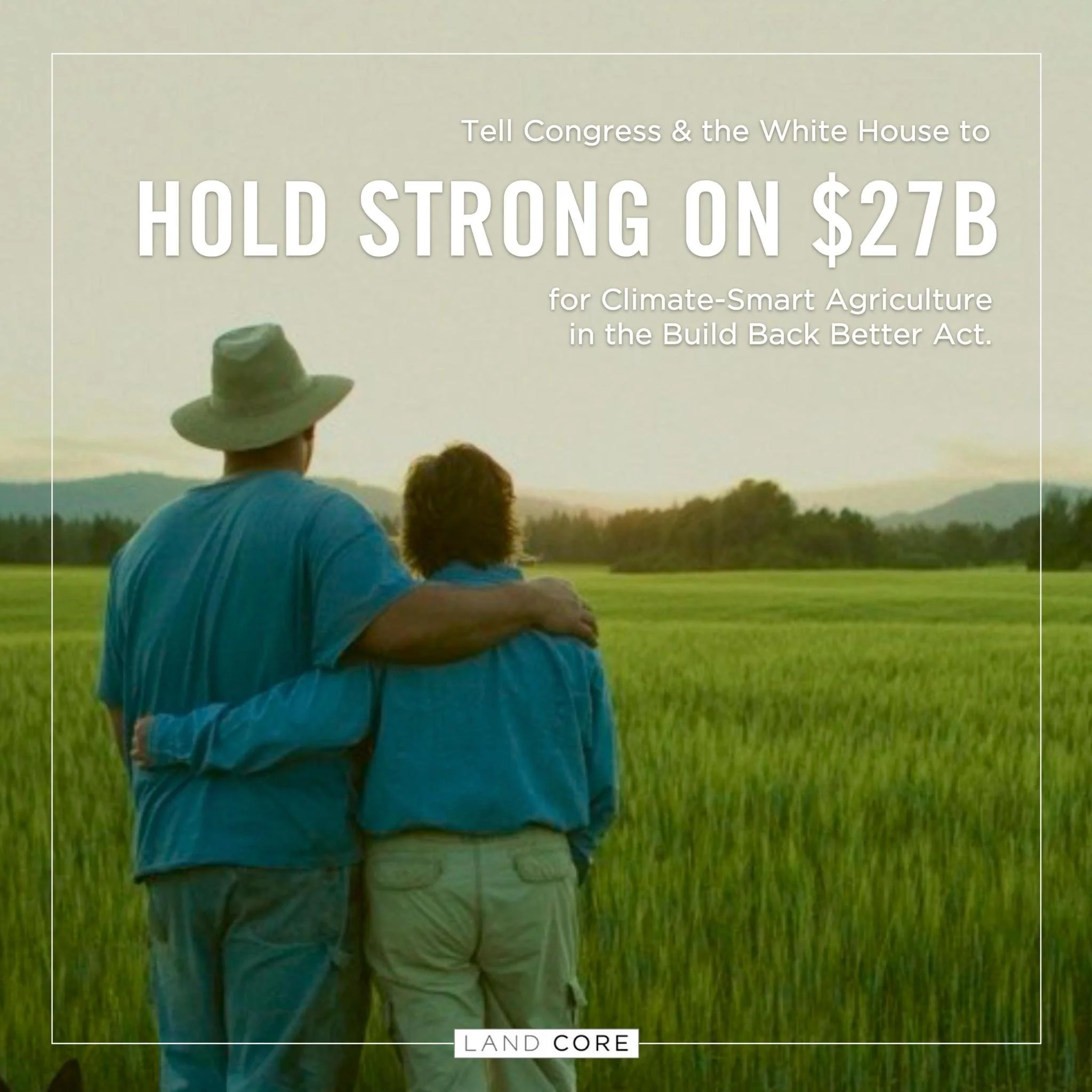
The Build Back Better Act was reintroduced yesterday as a $1.75 trillion bill, down from its original $3.5 trillion. While there were cuts to many portions of the bill, we are thrilled to share that the provisions for climate-smart agriculture were left practically untouched - delivering a historic $27.15 billion for USDA conservation programs. This is the largest investment in conservation since the dust bowl!

Many of the big policy issues we have been discussing and sharing with you over the last few months are being decided on in the coming days. Thank you all for everything you’ve been doing to advance this work, and we will be watching closely to see where things land.

In this series of conversations, our co-founder & executive director, Aria McLauchlan, chats with Carrie Dorr (seasoned entrepreneur & founder of Pure Barre, and Land Core board member!) about regenerative agriculture & soil health, Land Core’s work, and ways to get involved.

The GCSA represents a significant opportunity for business to harness the economic and environmental potential of improved land management, and recognizes the vital role USDA can have in providing meaningful infrastructure to enable US farmers, ranchers and foresters to access private sector capital and empower new market development.
By focusing, beyond carbon, on a broader ecosystem services market approach, and standardizing monitoring, reporting and verification (MRV) protocols, this Committee can ensure the GCSA does not miss the mark on this enormous opportunity to support soil health and climate-resilient agriculture.

In this wide ranging discussion with NCAT's Agricultural and Natural Resource Economist Jeff Schahczenski, Land Core’s co-founders talk about our work, theory of change and their backgrounds, and take a deep dive into the Land Core Risk Model and its potential to transform US Agriculture.

We’re absolutely thrilled to announce that Land Core has been awarded a generous 3-year operating grant from the Mighty Arrow Family Foundation to support our federal policy and advocacy work to advance soil health for a resilient food system that delivers healthy food to all.
Policy updates, a new grant announcement, fall events, and more. We hope you can take the opportunity to reflect on the immense work done by our collective movement this summer to raise awareness about the need to build a resilient, soil health-focused US agriculture.

The Senate today passed a $3.5 trillion budget resolution as part of the President's infrastructure agenda, which would give $135 billion to the agriculture committee to allocate over the next 10 years. We're calling on Congress to use these funds to double the investment in USDA conservation programs and double technical assistance funding to help producers build a soil health-centered, climate-smart agriculture.

It has been another big week, and month, at Land Core as we have been working hard to ensure soil health and climate-resilient agriculture are included in the historic infrastructure legislation on the table in Washington.
Risk-informed pricing is a market-based path forward to pay for the transition to resilient, climate friendly, soil health practices, and can also address some of the challenges that carbon markets, while they may hold enormous potential in the coming years, are ill-suited to address.

The passage of the Growing Climate Solutions Act (GCSA) in the Senate last week reflects the growing recognition of the essential, positive role our agricultural producers will play in coming climate mitigation strategies. This month, we share a policy memo outlining how recognizing the risk-mitigation value of soil health could unlock the pathway to carbon markets, while addressing several persistent issues with equity and access.

It is essential to acknowledge that on-farm resilience is at the core of how we ensure the stability and reliability of our agricultural supply chain, and that soil health, in turn, is at the center of on-farm resilience.
USDA has an opportunity to increase the resilience of our suppliers and encourage our growers and livestock producers to adopt soil health practices in order to de-risk our national food, fuel and fiber supply chains through non-legislative actions that can be initiated by setting agency priorities and enacting the following concrete recommendations.

Compeer Financial and Land Core have announced a new partnership in which the member-owned Farm Credit cooperative will support the soil health non-profit’s cross-sector initiative to build a predictive model of the risk-mitigating benefits of soil health practices… “The Land Core Risk Model will give financial service providers the missing tools they need to quantify the risk reduction benefits of soil health practices,” said Harley Cross, Co-Founder and Director of Strategy at Land Core.
We’re thrilled to announce that Compeer Financial (the third-largest cooperative in the Farm Credit System, with over $25 billion under management) will be partnering on the development of the Land Core Risk Model. Read on to learn the impact this will bring to the project, and catch additional policy wins & opportunities.
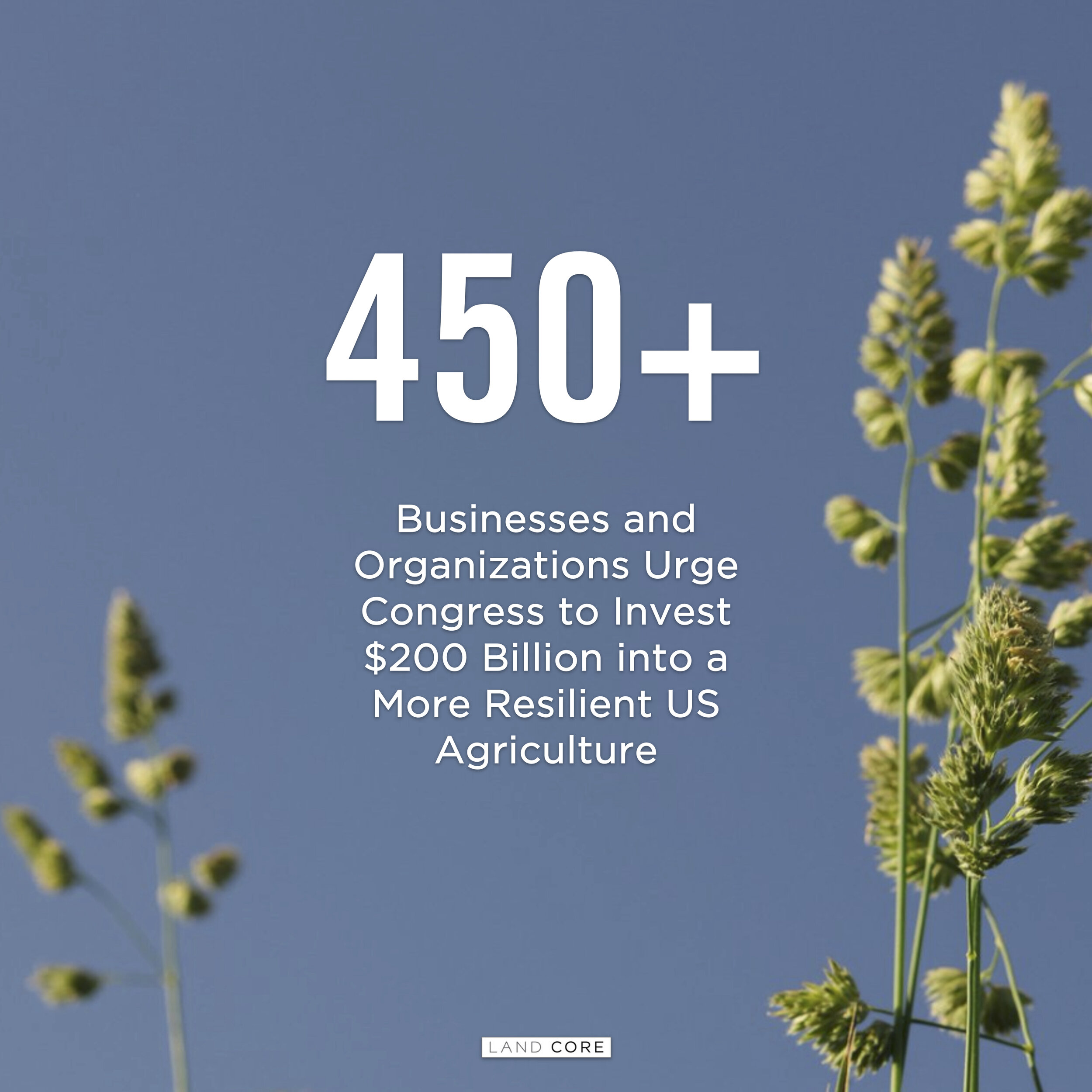
Land Core and 450+ businesses and organizations have urged Congress to invest $200 billion into a more resilient US agriculture through the President's infrastructure package. Thanks to all who signed on to this critical initiative, and please continue to share the letter with your networks and Members of Congress. We cannot let US ag be left out of a major infrastructure and jobs act.

There’s a unique opportunity at hand for organizations (and individuals) invested in soil health to support getting agriculture its fair share of the President’s proposed $2.2 trillion infrastructure package. Join a growing group of legislators, organizations & businesses in calling for Congress to prioritize climate-resilient agriculture now.
With Spring in full swing, we are wishing our farmer and rancher friends across the country the very best during one of the busiest times of year. It has been an equally action-packed month in Congress, with multiple opportunities emerging to advance soil health. Read on for federal policy highlights, our comments to USDA on risk mitigation as an essential approach to incentivizing soil health, and more.

USDA has the opportunity to transform how we support our producers in their transition to a more climate-resilient and regenerative agriculture system in the U.S.
In particular, there is enormous opportunity to advance critical infrastructure for the scaled adoption of soil health practices––resulting in production agriculture that reduces risk and is more profitable, productive and ecologically-sound––through non-legislative actions that can be initiated by setting agency priorities and enacting the following concrete recommendations.

With the arrival of Earth Day, there has been a flurry of legislative activity in the US Congress, including some major proposals that impact soil health and agriculture.
We are thrilled to see some of Land Core’s key messages incorporated into a number of bills, with language supported by both parties and in both chambers! Read on for a recap of “need to know” bills.
Risk modeling news, policy updates, and ways you can get involved in building soil health. We hope you are as excited as we are for the emergence of Spring, bringing with it new life and new opportunities!

Read the February edition of our monthly newsletter for risk model project updates, a new bill tracker resources tab and alert list sign-up, review of the first House Ag Committee hearing, events, news and more!
2020

Land Core contributes key recommendations to new Berkeley Food Institute report highlighting the growing interest and opportunities for public and private sector investment to support a rapid transition to regenerative agriculture.

We wanted to take a moment to wish you a wonderful holiday season. We hope this season brings you time to celebrate family, community and our common connections, whether near or far.

Land Core presented soil health policy recommendations directly to the Biden-Harris Transition: Agency Review Team for the United States Department of Agriculture (USDA) during a vital transitional moment for US agriculture.

While much of the focus has been on emerging carbon markets, measuring and rewarding soil carbon sequestration has significant challenges. Land Core’s work is offering a new way to bring farmers more immediate incentives; based not on quantifying carbon, but rather quantifying risk.

During this unprecedented moment of awareness and interest in soil health and regenerative agriculture, Land Core remains laser focused on advancing concrete policies and building missing infrastructure that will translate momentum into lasting, systemic change. Help us continue to do this work.

Catch up on our risk modeling work, growing team, and policy recommendations for the incoming Biden-Harris administration and share yours as we strengthen our collective commitments to transforming our food and agricultural system.

Soil Health is a non-partisan, keystone issue that provides the common ground to move America forward.
These executive, legislative, and agency recommendations are designed to ensure the incoming administration has clear guidance on how to take bold action in advancing soil health to build a more resilient and profitable US agricultural system.

Land Core Co-Founder and Executive Director, Aria McLauchlan, spoke on the Adaptation & Mitigation Synergies in Agriculture panel of the UC Davis October 2020 Catalyzing Adaptive and Resilient Food Systems workshop, addressing the central role of soil health in building adaptive and resilient food systems.

Land Core submits comments to the United States Senate Committee on Agriculture, Nutrition, and Forestry: Hearing to Review S. 3894, The Growing Climate Solutions Act (GCSA) of 2020.
This bipartisan bill recognizes the economic and environmental potential of improved land management, and the role of USDA in providing infrastructure to enable US producers to access private sector capital.
We’re pleased to introduce our new and improved bill tracker! This major update brings our tracker from a spreadsheet to an interactive tool with search and filtering features, available for use on desktop and mobile.

A recap of our YTD 2020 highlights, including: Policy News, Sneak Peek: Land Core's Newest & Biggest Initiative Yet, Organization Updates
2019

We hope this finds you well and warm.
Today is not only Giving Tuesday; it also happens to be the first birthday of Land Core’s official non-profit status! (We became a California public benefit corporation on Dec 3. 2018)
Help us build on the work we’ve achieved thus far, expand our small but mighty team, and launch us into the new decade.
Here are some of our highlights from an incredible 2019:
Built a broad coalition and passed language in the House FY20 Ag-Appropriations Bill to create an Outcomes-Verified Soil Health Program within UDSA-NRCS
Led implementation of the new Soil Health Demonstration Trials with USDA-NRCS

There is an ever-growing chorus of scientists, farmers, ranchers and businesses acknowledging healthy soil as one of the most effective tools to build resilience and mitigate the risks of flood and drought on agricultural land.

In response to the request for information from the House Select Committee on the Climate Crisis, Land Core recommends that Congress adopt the following suite of practical, non-partisan policies

View the memo of recommendations submitted to NRCS-CIG regarding the implementation of the On-Farm Trials and Soil Health Demo Trials.

Land Core submits comments to the Senate hearing on climate change and the agriculture sector. We focus on synergies in adaptation and mitigation, the importance of soil health in mitigating risk, and opportunities for Congress to create market-based incentives and infrastructure that will encourage more producers to focus proactively on building soil health.

Land Core submitted comments to the first hearing on soil health in the 116th Congress that helped to shape the direction of this important moment for both Congress and USDA.
2018

Dear friends and colleagues,
We've been super busy here as you might imagine! As most of you know, the Farm Bill finally passed last week when we were in DC for meetings. While there's always more work to be done, from our perspective, it's a reasonable bill with some real wins for soil health.
We wanted to give you the news that although our amendment (to create an Outcomes-Verified Program) did not make it into the Farm Bill, the "Soil Health Demonstration Pilot Project" that we were also championing did get through... and we have a lot of support to get our language added down the line. Thank you and congratulations to all of you who signed our letter of support

We are proud to announce that Aria McLauchlan, Co-Founder & Executive Director, of Land Core has been selected as a 2018 Stone Barns Exchange Fellow.